Showing posts with label Budapest. Show all posts

Thursday, March 23, 2023

BUDAPEST WALKING TOUR WITH ANDREA MAKKAY

DAY TWO  
We hired a personal guide in Budapest Hungary for 2 days while there on a recent trip. Andrea Makkay is a native of the Hungarian capital and grew up during the Communist era. She is intelligent and witty, speaks great English and is enthusiastic as a professional tour guide, and is very flexible as she steers the tour's itinerary to what her client is interested in seeing of this beautiful, historical, vibrant city.
 Bush statue near the 
 American Embassy Budapest 
Our first day of touring with Andrea was a full day minivan tour, driver and umbrellas included. That day cost €480. It was €140 for the second day, a half-day waling tour through the Pest portion of the capitol.
METRO
In the days before we met Andrea we had been to the Opera, to see a performance of Die Fledermaus. We had strolled Heroes Square and the spacious City Park and spent an afternoon soaking in the Széchenyi Thermal Baths. So, molding our personalized tour to other destinations Andrea had us get on the Metro.
Everything we saw on this second day was within walking distance from our K+K Opera Hotel, but we took the Metro to save time.
Around the corner from our hotel was the beautiful Hungarian State Opera House and the Opera Metro station and at a kiosk Andrea had us purchase 10 pairs of single use Metro tickets. When we got on the Millennium or Yellow line of the Metro, she showed us how to validate our tickets in a little machine on the quaint rattling train and we rode it to last stop at Vorosmarty Square (Ter in Hungarian).
We could have taken the Millennium line (so named because it was constructed in the late 1800s in celebration of the 1,000-year anniversary of Hungary) the opposite way to the City Park and the Széchenyi Thermal Baths, but we had decided to walk on a beautiful warm and sunny early January morning.
Cafe Gerbeaud, Budapest

It was early and the Vorosmarty Square was empty, but Andrea said it will fill up with shoppers as the day progressed as it is the beginning of Vaci Street (utca in Hungarian.) This pedestrian thoroughfare starts at the Great Market Hall and is lined with restaurants, cafes and tourist shops.
Sadly the popular Christmas market that is held in Vorosmarty Square was done for the season, but Andrea gave us the history of the famous Café Gerbeaud, and recommended we stop later for a coffee and a pastry.
DOWN BY THE RIVER
From Vorosmarty it was a short walk to the Danube River where Andrea pointed out the Chain Bridge, the first bridge built to cross the storied waterway and join the cities of Buda and Pest into one entity.
The Chain Bridge, Budapest

Here there is an above ground trolley and access to tour boats that cruise the Danube.
The Chain Bridge was under renovation with cyclone fencing keeping everyone away.

ST STEPHEN'S BASILICA
More than half of all Hungarians follow the Roman Catholic religion. It’s dominance in this Central European country was helped along by St. Stephen who “spread the word” by the sword when he became king in 997.
Beyond Hungary the Russian orthodox religion is prevalent.
St. Stephen's hand
It was a short walk up from the river with the chiming bells of St. Stephen’s Basilica filling the air as Andrea filled us in on the history and particulars of the basilica. For instance, it was completed in 1905 and it is 96 meters tall (315 ft), the same height as the Parliament building, inferring church and state are of equal importance. The number 96 is important to Budapest because of it commemorates the settling of Hungary in 896.
There are no skyscrapers in the center of Budapest as the law requires all buildings to be shorter than 96 meters. 
Anyway, St. Stephen’s Basilica was majestic from the outside, but there were church services being held and no touring allowed. Andrea begged us to go on our own, after our tour was over. We did the next day, but without her guidance lots of things were missed, although we did get to see St. Stephen’s right hand encased in a reliquary. There is a nominal fee to enter the basilica with tickets purchased from a small office across the street from the basilica.
The square in front of the basilica is lined with very pleasant cafes and restaurants.
LIBERTY SQUARE
Victims Memorial Budapest

The next stop on our half-day walking tour with Andrea was Liberty Square. Here we first stopped in front of the memorial for Victims of the German Occupation and Andrea pointed out the irony, as many Hungarians were complicit in the holocaust. An anti-memorial is set up just across the narrow street from the official memorial showing the remnants of Jewish lives from the atrocities, and is adorned with barbed wire and protest flyers and artifacts like shoes and suitcases. It was a sobering reminder of the cruelty.
In the center of Liberty Square is the one lone Soviet memorial left standing in Budapest. All the rest have been removed to Memento Park on the outskirts of the city. The reason the obelisk, topped by a golden Soviet star, had been left in place was because it is a memorial to the Red Army soldiers who died trying to liberate Hungary from the Nazis. That control stuff came later.
Red Army Memorial
Liberty Square

On one end of the square is the United States Embassy, and nearby are two statues of U.S. Presidents, Ronald Reagan and George H.W. Bush. Both were instrumental in the collapse of Communism. 
Andrea told us how the crown jewels of Hungary were spirited away to the United States’ Fort Knox for safekeeping before the war. Later returned by Jimmy Carter in 1978 the crown jewels are now in the main rotunda of the Parliament building, and are the highlight of a separate tour we would take the next day.  
Andrea said they should also erect a statue of Carter in Liberty Square
Here's some more history of the crown jewels of Hungary
PARLIAMENT BUILDING
We would take the audio tour of the interior of the beautiful Parliament Building the next day, but on our walking tour Andrea had us walk through the spacious Kossuth Square, dodging trollies and view this magnificent Gothic revival structure built to rival the Austrian dominance at the time. It was meant to be completed in time for the 1896 Millennial celebration of Hungary, but finally completed in 1904. During the Soviet era a massive red star was atop the main dome, but now that’s in a display of the history of the Parliament Building that is part of the walking audio tour.
Hungarian Crown Jewels

The front entrance to the Parliament faces the Danube, but the rear side, facing the square is dramatic as well. Andrea had us go the visitor center on the far end to get a closer look (and to use their nice bathrooms).
As we headed towards the metro on the other side of the Parliament Building and Kossuth Square Andrea pointed out the Szekler flag of Transylvania that was flying from the Parliament Building. In reparations for its role in WWI, Hungary signed the Treaty of Trianon and lost 75% of her pre-WWI territories. Suddenly people who were once Hungarian were now Romanian, Slovakian, Croatian, Serb, etc. There are factions within the Hungarian government that feel Transylvania should be Hungarian again. It was reminiscent of what is happening currently in Ukraine and it’s conflict with Russia.
The Parliament Building Budapest
To read more about the complicated history:
TOBACCO ROAD SYNAGOGUE
Ignoring the alluring Szamos Chocolate Museum near Kossuth Square and quickly eyeing the Memorial honoring those who perished in the October 25, 1956 revolution against the Communists (with sobering faux bullet holes splayed along the glass structure), we entered the Red line Metro stop. 
Kossuth Sq escaltor

It’s very deep and the escalators are very swift, so hang on! Andrea explained that this part of the metro also doubled as a bomb shelter and the speedy escalators would spirit people away from danger.
We took the metro to the Dohany Street Synagogue, the largest in Europe. The synagogue is so named after the tobacco factory that was once located nearby. Dohany is tobacco in Hungarian.
Raul Wallenberg Memorial Park 
at Dohany Synagogue
Dohany Synagogue charged an admission to tour the interior, like all the churches that we visited in Budapest, but Andrea instead led us around the exterior, explaining the architecture and pointing out sobering details from the street.
Over 400,000 Hungarian Jews died during the Holocaust and many were sent to Auschwitz, but the synagogue was where many of those who died while in the Ghetto during the Nazi occupation are buried. Though we didn’t enter the grounds we could see the markers of those unfortunate souls from the street. She also pointed out the Raoul Wallenberg Holocaust Memorial park, easily seen through the railings in the rear courtyard of the synagogue complex. Wallenberg’s efforts during WWII saved thousands of Jews. The memorial features a metallic weeping willow on whose leaves are inscribed the names of the victims during this time.
If you’re interested in reading more about the Dohany Synagogue:
THE GREAT MARKET HALL
We took an above ground trolley from the Astoria stop to Flovam Square for the next and final destination of our half day walking tour with Andrea Makkay, The Great Market Hall. Located near the Liberty Bridge which leads directly across the Danube to Gellert Hill, where we were the previous day, the trolley dropped us off on a traffic island in the middle of a busy street. 
Great Market Hall Budapest

The Great Market Hall is perhaps the most touristed destination in Budapest with three floors of shops offering produce, meats, dairy products, spices like Paprika, wines, tourist souvenirs and even housewares like pots and pans. Also found on the upper mezzanine are several eateries and restaurants. In the basement are the fish mongers and specialty butchers. On the mezzanine level several eateries and restaurants are located. This massive airy building was erected in 1897 and the façade is decorated with famed and colorful Zsolnay tiling which is found throughout Budapest.
Andrea gave us a quick once-over about the history of this vast indoor emporium and after some pleasantries we said our good-byes and left us to explore the market ourselves. It was a wonderful tour; we crammed a lot in over the two days we were with Andrea. 
Great Market Hall interior

So, afterwards we walked the aisles, found a wine kiosk where we bought several Ikon winery reds for ourselves and friends, while ignoring the Tokaj sweet dessert wines that were as plentiful. We then bought chocolate and decorative pouches of paprika for more gifts, souvenir gifts for the grandchildren and another key chain to add to our burgeoning collection of such keepsakes from around the world.
If you end up at the Great Market Hall in Budapest, remember there are lots of stands offering similar products, like the paprika pouches. If you go you can negotiate on the price. It's easier if you’re buying a lot like we were. The gaily printed pouches with wooden spoons to dole out the spice do make great gifts, but if you're not satisfied with the price move on to the next vendor.
THE WOODEN SPOON
We ended our visit to the Great Market Hall with lunch at the Fakanal restaurant, located on the mezzanine at one end of the market. Fakanal means wooden spoon in Hungarian. It was a cafeteria style restaurant that offers traditional Hungarian foods and has a small gypsy music group playing from noon until 3 pm.

JUST DESSERTS
With our souvenirs in tow and our bellies filled with hearty Hungarian goulash we strolled down the famed Vaci Street, but basically ignored all the tourist shops and cafes. Afterall, we were headed to Cafe Gerbeaud in Vorosmarty Square where we began our walking tour with Andrea that morning.  
First opened in 1858 and at its present location since 1870 Café Gerbeaud was where Budapest elite took their coffee. Opulent décor, crystal chandeliers and an array of desserts and coffees and teas and now offering a breakfast and bistro menu a visit to Café Gerbeaud is a chance to experience what life was like during the height of the Austro-Hungarian Empire.
Cognac Cherry Dessert

Our reward for hoofing it around Pest with Andrea Makkay was to enjoy some decadent desserts at the café. Though I got the Royal Chocolate Cake slice, Janet won this round by ordering the Cognac Cherry Dessert that was so beautiful she didn’t want to eat it!
BEYOND THE TOUR
This is a small “slice” of Budapest, pun intended. We saw a lot, but there is much more to see in Budapest.
Later that evening we went on a pub crawl to the Ruin Bars, and the much quieter Tuk Tuk Bar. The next day we toured the Parliament Building and saw the crown jewels. We finally visited St. Stephens Basilica and got to see his 1,000-year-old right hand in its reliquary, but without Andrea to guide us we just took in the beauty of the basilica. We then had an afternoon coffee at a café on the square before the basilica. We rode the Budapest Ferris Wheel and after tiring of eating so much rich goulash over the past number of days we had comfort pizza at the Trattoria Pomo D’Oro, which was also on the basilica’s square.
Parliament interior

Our first meal in Budapest was at the Menza Restaurant. Menza is the Hungarian word for canteen, and this lively place that served traditional Hungarian dishes had retro-60s era décor. We had to wait briefly for a table, so we hung at the bar and some drinks.  The menu was translated into English and the portions were massive. We each had a garlic soup topped by a Hungarian pastry that was filled with sour cream. That was enough, but our entrees, Janet had Pork and I had a Wiener Schnitzel had our bellies bursting!
Thanks for reading. Budapest is beautiful, historical and vibrant.
Go!
Love Janet and greg

© 2023 by Gregory Dunaj

Tuesday, March 7, 2023

BUDAPEST MINIVAN TOUR WITH ANDREA MAKKAY

DAY ONE
We had hired Andrea Makkay, a local tour guide, for a full day tour of Budapest with a minivan and driver included in the price. We also hired Andrea for a second half-day walking tour the next day. 
Here is a brief synopsis of what we saw our first day.  
Parliament Building Budapest
from the Fisherman's Bastion
We were fortunate that we had the minivan and driver for our first day of touring this beautiful city. Until that morning we had been blessed with unseasonably warm weather and sunny skies, but the day was rainy, raw and blustery. Thankfully the driver had umbrellas for us whenever we stopped. 

Gellert Hill
The first stop was Gellert Hill on the Buda side of the Danube. Named for a St. Gerard (Gellert in Hungarian), the poor fellow met his martyrdom in 1046 by being placed in a spiked barrel and rolled down the hill. 
Liberty Statue
We parked near the Citadella, a kind of fortress, that was being renovated and sectioned off by fencing so we couldn't tour the grounds, although we did get a commanding view of the entirety of Budapest and the Danube. Andrea told us about the complicated history of occupations in Budapest of the Austrian-Habsburg dynasty and with the Nazis and then the Soviets after WWII. 
Gellert Bath
interior

From afar we could see the Liberty Statue, erected by the Soviets in 1947 when it was called Liberation Statue. It is just one of a handful of Soviet-era statues left in place after the fall of Communism. The Liberty Statue is set on the pinnacle of the fortress, majestically holding above her head a palm leaf.   
Gellert Bath
interior

Driving down the hill we took a winding route through an affluent neighborhood of beautiful residences and embassies and parked down by the Gellert Baths. Opened in 1918 this beautiful Art Nouveau bath is a part of the Hotel Gellert. We parked and Andrea walked us through the interior. Both the hotel and the baths are soon to be renovated so if you're going to visit make sure they are open. 

Memento Park
Andrea was pleased we had expressed interest in seeing Memento Park. It is a collection of Communist-era propaganda statuary and commemorative plaques of different events when Hungary was reluctantly a part of the USSR. After the demise of Communism and the withdrawal of Russian troops all the statues were taken down, but instead of destroying them they were put in this open-air park specifically set beyond the city limits of Budapest.  
Memento Park
 Budapest
Andrea, who grew up during the Soviet occupation, gleefully and sarcastically pointed out the many "liberation" statues and their gloomy history as we walked the three infinity-shaped paths which led to a blank wall, and an appropriate dead-end. 
The weather complied and turned very rainy and windy and chilling and was perfect for revisiting this sad, dour period.
Memento Park, Budapest


There is a fee to enter the park, but there is also a free exhibition across the small road. In the Barracks photo and cinema exhibitions detail the events of the Hungarian 1956 revolution and the eventual fall of Communism in the late 1980s.
It is possible to take public transport to Memento Park, but it was a good use of the minivan, especially on this miserable afternoon.  

Castle Hill, Buda 
Castle Hill, Budapest

The rain abated by the time we returned to Castle Hill in Buda, where we had lunch at the 21 Hungarian Kitchen. On a beautiful cobblestoned street glistened by the rain Janet and I shared a pate fois gras appetizer. Hungary is the world's second largest producer of fois gras, after France. We all had a traditional Hungarian dish of Chicken Paprikash with dumplings, and I had a glass of Ikon Cabernet Sauvignon from Hungary.

The Chicken Paprikash was rich and filling on this seasonably winter day. Here's a recipe.

After lunch we toured the rest of Castle Hill on foot. We visited Matthias Church and Andrea spoke of the history and pointed out charming details we definitely would have missed had we just winged it on our own. 
At the church I lit a votive candle for a recently deceased cousin who was Hungarian.
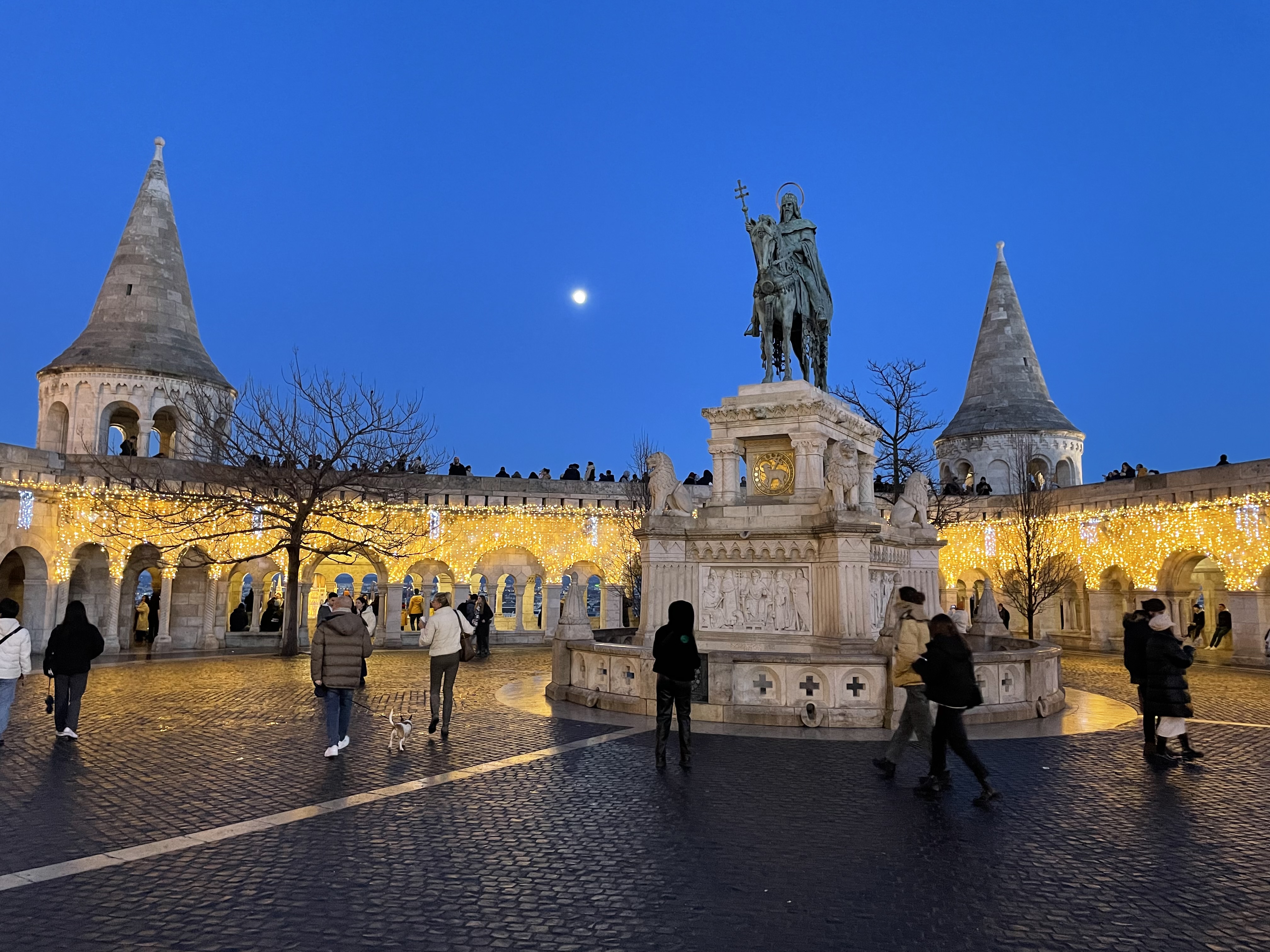
We lingered on the square outside Matthias Church and the Fisherman's Bastion. This vantage point gives a spectacular view of the beautiful Parliament Building just across the Danube River and is perhaps the most popular tourist stop in Budapest. 
Fisherman's Bastion, Budapest
We did not go to the Buda Castle, and because we had the minivan we did not take the funicular that starts at the Chain Bridge, the first bridge that connected the separate cities of Buda and Pest.
Fishman's Bastion,
Budapest

And, we learned later from the History Channel's show, "Cities of the Underworld" S1E6 that the cave systems all throughout Budapest can be explored and that there is a unique attraction called Hospital in the Rock. It is a cave hospital under Castle Hill that also doubled as a fall-out shelter during the Cold War. 
Our guide, Andrea Makkay, guides the show's host through the hospital. In an earlier blog entry there is a link to that episode. 
There is also a small church in a cave just across from the Gellert Baths. Now open to the public for a nominal fee the Cave Church was sealed off by the Communists in the early 1950s until the late 80s.  At the entrance is a statue of St. Stephen, who converted everyone to Catholicism, whether they wanted to or not when he ascended to the throne in 1000 A.D. 
St. Stephen

We took the scenic route back to the hotel, crossing the Danube and driving through the shopping areas of the Pest side of the city.

The next day was our half day walking tour


Happy travelers, Budapest
ANDREA MAKKAY, TOUR GUIDE BUDAPEST

Thanks for reading,
Love Janet and greg
© 2023 by Gregory Dunaj

Tuesday, February 28, 2023

TOURING BUDAPEST WITH ANDREA MAKKAY

THE IMPORTANCE OF TOURS 
Andrea Makkay and Janet

You can do your research and read guidebooks until you are bleary eyed, and your paper cuts get infected. You can go online and watch videos about places you want to visit or catch a History Channel show about the ancient or recent history of your destination. You can even pull that dusty encyclopedia off the shelf. You can buy a map and look at photographs and read the menus of restaurants that whet your appetite. And, after all that preparation, you may feel you are ready to see everything at your chosen destination, and yet it is a guarantee you will miss something in your travels.
Unless you just want to idle away your time lounging poolside or lingering over an espresso in a faraway café, never underestimate the importance of being led on a tour.
TRAVEL v. VACATION
To lounge is a vacation. To explore and experience local customs is to travel. Both are very rewarding, but to get the most of your travels, a tour is recommended.
We’ve attempted to travel alone and though we have had some success, mainly because of Janet's meticulous planning, we still end up running around like headless chickens and missing things. Too often our reminiscing over past travel destinations is about opportunities missed. It is the nuance, the essence of a destination that requires a tour.  Without a tour you’re guessing and a missed opportunity at a truly rewarding experience.
Raw cashew in Costa Rica

THAT’S A STATUE  
Tours can be expensive though (and we don’t like spending extra money since we’ve already traveled so far to get to a place), but we have learned that the knowledge and experiences gained from a tour can usually be invaluable…usually.
Over the years we have taken group tours, walking tours, bus tours, van tours with several couples, and horse and buggy tours and our experiences have ranged from awesome to middling to flat-out disasters.
One tour in Costa Rica had us plucking the fruit of a cashew tree and listening to Howler Monkeys. A horse carriage tour in San Antonio had the cowboy clad guide who hailed originally from Brooklyn, New York pointing out “a statue made of metal”. A tour in Tenerife had us drinking wines from the Canary Islands with amateur vintners from Lanzarote, while another one pointed out the dive bars of Charleston, South Carolina. In the rain of York, England we simply circled this walled city a couple of times in a hop-on/hope-off double decker bus, periodically dodging raindrops after seeing something interesting. In Chester England we ran higgledy-piggledy in every direction for we had a very limited time before we had to go… In Split, Croatia we walked through the warren of alley ways of the former palace of Diocletian simply amazed we were even there.
I’m partially kidding about tour disasters. The urban cowboy in San Antonio did point out some good Mexican restaurants.
ANDREA MAKKAY
In all our travels though we have never taken an inclusive one-on-one tour. As we did our research about Budapest, we quickly learned there was a lot to see and the five days we allotted ourselves in this vibrant Hungarian capitol may have been wasted had we not hired a seasoned tour guide in Andrea Makkay.
It was the greatest travel decision we had ever made.
She was articulate, intelligent and spoke perfect English and was very engaging and enthusiastic in showing off her hometown of Budapest. She also adjusted our tours as we showed interest in various destinations, rather than taking a cookie cutter approach to showing us the city.  
For example she learned we had already gone to the Opera, the Széchenyi Thermal Baths, Heroes Square and the City Park and so concentrated our tour in a different area of Budapest. We also expressed an interest in seeing Memento Park, a collection of Communist-era statues that had been removed from Budapest and now sit in the park just on the outskirts of the city, and she made that happen for us. She also learned I collect hand-held subway maps. I have them from Tokyo, Stockholm, Barcelona, Paris and London. She showed up with a metro map of Budapest, and then taught us how to buy our fare from a station kiosk.
We hired Ms. Makkay for two days. The first was an 8-hour tour by minivan and the second was a ½ day walking tour.
Of course, Janet made all the arrangements. Her research led her to Andrea Makkay and after a series of emails over availability and payment we asked Andrea to guide us through Budapest. The payment was tricky though. She wanted cash in Euros, not Hungarian Florins as that currency has been unpredictable. 
Liberty Statue Budapest

Unsure we would be able to withdraw Euros from Hungarian ATMs we made arrangements to convert dollars into Euros with our local bank. We traveled to Hungary with the funds. 
It was €480 for the full day with the minivan and driver and €140 for the half day walking tour. 
To top it off she's famous! She appears in an episode of the History Channel's Cities of the Underworld, S1E6 where she talks about the secret caves of Budapest, and the hospital under Castle Hill that was also used as a fall out shelter.
Budapest is a fascinating city and she is a knowledgeable tour guide. If the road takes you to Budapest, be sure to contact Ms. Makkay.


Thanks for reading. Stop by again to read about our tour with Andrea Makkay soon.
Love Janet and greg
© 2023 by Gregory Dunaj

Wednesday, January 25, 2023

SOAKING UP BUDAPEST

PARTY ANIMALS?
Budapest 

Full discloser: Your favorite wanderers certainly can’t burn the candle at both ends, at least not at our advanced age, but in Budapest we didn’t stand a chance with keeping up with the revelry. Expecting a Communist-era dreariness to the Hungarian capital, Budapest instead is a vibrant city with more to offer than ornate buildings from the Hapsburg dynasty era and lots of history.
A thriving nightlife of live music venues, raucous nightclubs and trendy (swanky) rooftop bars overlooking the city, and trendy (hipster) Ruin bars that are found in the old Jewish quarter of the city awaited us as well as a lively thermal bath scene that was packed even in the middle of winter!
Budapest lived up to the hype of being a party destination and though we “tried” to enjoy some of the antics we just couldn’t compete! There were two attractions that everyone visiting Budapest should experience.
ROCKING THE ROMKOCSMA
The Ruin Bars are a number of drinking establishments that have been opened in previously neglected pre-war buildings in the Jewish Quarter. They are very trendy and so popular it is mostly overrun by tourists and backpackers and foreign students rather than locals, but are so off beat and bizarre it should be on your list to go...no matter your age.
Szimpla entrance


Szimpla Kert was the first Ruin Bar (romkocsma in Hungarian) to open in the old derelict Jewish quarter. It is a heavily graffitied warren of corridors and open spaces and nooks where there are 9 separate bars over two floors. There was live acoustic music when we were there. There was an open-air courtyard with old cartoons being projected on the side of the building in the middle of this gritty but convivial complex. It is very tourist friendly and though there was a youthful vibe, there were plenty of older people (ahem) shuffling through grabbing a beer or wine. In our research we saw Szimpla Kert and knew we had to go. There is no entrance fee, and the place gets very crowded as the night advances. We lingered awhile to listen to the acoustic group, scoring a couple of seats near the alcove that served as a stage. We were able to pay for our drinks with a credit card and the bartenders all spoke English.
Haver

Near by to Szimpla Kert is Karavan, a food truck courtyard where you can eat everything from Hungarian to burgers to vegan food.
Szimpla Kert is not the only ruin bar to be found in Budapest, but it is the most renown. The bar was crowded while we were there, and it was an early Friday evening the first week of January. In the summer the place must be packed to the gills.
FLOUNCING IN THE FÜRDŐ
Another unique attraction of Budapest is the prevalent spa culture. There are numerous thermal baths found throughout the city and are popular with locals and tourists alike and early on we also decided we had to go to Széchenyi Gyógyfürdő.
Budapest lies on a geographical fault line and where the hills of Buda mash up against the plains of Pest thermal springs bubble up everywhere. It is said a thermal spring will erupt if one pokes a hole in the ground anywhere around Budapest. Pest is the Slavic word for furnace.
Széchenyi Gyógyfürdő

The spa culture was started by the Romans and during the century and a half rule by the Ottomans many ornate bathhouses were built. Two still in operation today are the Rudas Baths and the Kiraly Baths, but we wanted to go the most popular spa in Budapest, Széchenyi.

Opened in 1913 the ornate neo-Baroque and neo-Renaissance baths feature three outdoor pools. One is a lap pool where a swimming cap must be worn, while the other two are for soaking and relaxing in the heated water. One of the outdoor pools also features a whirlpool that whips you around. There are also 12 indoor pools of different temperatures, including a cold plunge pool and saunas. Széchenyi Gyógyfürdő is the largest thermal spa in the Budapest area and on a late Tuesday morning the first week of January it was packed. 
Széchenyi Gyógyfürdő

No need to be shy about this experience. You will find people of all ages and various degrees of bulges and curves that frequent the baths and after seeing a couple of speedo-hiding belly overhangs you’ll feel right at home.  
SPARTY ON HAVERS
Now, the nighttime revelry party held at Széchenyi on Saturday nights from mid-February to November might be a bit more intimidating for some. Thankfully we didn’t have the chance to go, but from the website it seems like a frenetic event combining a club atmosphere with lights and music and the thermal baths. They call it SPARTY © (Spa-Party get it). Check out their website. SPARTY is a whole separate entrance fee structure. Alcoholic drinks are available.
(“Haver” is Hungarian for “dude”.)
Before you wade:
Széchenyi Gyógyfürdő

To get the best view entering Széchenyi enter on the far side of the golden dome to the entrance across the street from the zoo. After paying and activating a waterproof wristband that lets you through the turnstile and gives access to a locker, first go up the stairs to get a beautiful captivating view of the Széchenyi complex, before going down to change for the thermal waters. Just make sure you go to the right area. Férfi is man in Hungarian, and női is woman.
Here’s a 3d model of Széchenyi,
Costs
Széchenyi Gyógyfürdő
There are several tiers of entrance fees, depending on the time of day and whether you’d like a private changing cabin and a massage. Before 5 pm weekdays the entrance fee with a locker is HUF 9400 (about $25.00). After 5pm the price drops to HUF 9100. Széchenyi is open until 10 pm. Not sure about how long SPARTY goes on though. 
Don’t get a Standard Package at HUF 29000, like we did. Though this package comes with flip-flops (footwear is required), a disposable robe and towel, a swim cap and hair band it boosts the price to nearly $80.00. Better to bring your own towel and a shirt or robe to cover up when moving from pool to pool. Bring a bag to store your wet clothes and spend that money in better ways. If needed you can buy a suit at the bath house, but you must pay cash for that. Credit cards can be used for the entrance fee and other amenities, or you can online in advance.
Széchenyi Gyógyfürdő

Budapest card
This tourism card is great for discounts on entrance fees to the baths, admissions to museums and free public transportation, and guided tours. We briefly looked into that but decided to pay for a private 1 ½ day tour instead. Otherwise, the card is a great way to see a lot of Budapest and not spend a lot of money. Purchases are made on the amount of time spent in the city, i.e. 72 hours, 120 hours…  Széchenyi says they accept the card for daily tickets. 
Széchenyi is the most famous thermal bath in Budapest, but there are several others in the city. Here’s a website of all the thermal baths not just in the city but throughout Hungary.
PARTY POOPERS
We only scratched the surface of this city, but at least we got to experience two of the main draws. Both the ruin bars and the Széchenyi thermal baths were on the top of our list, but there’s so much more to Budapest, which we’ll tell you about soon.
Thanks for reading.
Love Janet and greg
© 2023 by Gregory Dunaj

Szimpla Kert