Showing posts with label Casco Viejo. Show all posts

Tuesday, June 16, 2020

A LAZY DAY IN PANAMA CITY


We had one final full day in Panama before heading home. Rather than disembarking from the M/S Panorama to immediately head for the airport, we decided to spend a day in Panama City. Our original idea was to explore further this gleaming metropolis, the largest city in all of Central America, but we ended up staying at the small rooftop pool at the Doubletree Hilton for most of the day before venturing out for dinner. Afterall the next day we would be back in the cold wintry Northeast; better to bask in the blazing heat with refreshing dips in the pool while nibbling at those fabulous Doubletree Hotel Chocolate Chip Cookies!


Our small ship adventure with Variety Cruises took us along the Pacific coasts of Costa Rica and Panama. Every day we were very busy with shore excursions to national parks and idyllic islands. These mini adventures were informative and fun and exposed us to the beauty and biodiversity these two Central American countries offered. We saw a vast array of plants, birds, fish and animals, from sloths to whale sharks to howler monkeys. Even prior to our departure we hiked in the rainforests of Monteverde and drank enough coffee at a plantation to keep us awake for weeks.

By the time we reached Panama City we were spent, and it was a good day to just relax. The only items on our agenda that last day were eating Doubletree Chocolate Chip Cookies and to swim in the pool.

GREAT NEWS
If you, my well-traveled reader, have ever stayed at a Doubletree you know about their cookies. Warm, gooey, chocolatey, nutty; these cookies are delicious. Well, just recently Doubletree posted their recipe for these delightful confections so you may bake them at home.

PANAMA CITY SIGHTS
We had already seen two of the main tourist attractions in Panama City; the Miraflores locks of the Panama Canal, and Casco Viejo, the old quarter of the city. It might have been nice to stroll some more along the cobblestone streets of Casco Viejo and perhaps linger over a drink at a tapas bar, but this section of the city was too far away from the pool at the hotel.
 
JW MARRIOTT PANAMA CITY
We could have gone to visit the remnants of Panama Viejo, the original site of the city that was ravaged by the pirate Captain Morgan in 1671. It’s a popular tourist attraction, but that too was far from the pool.

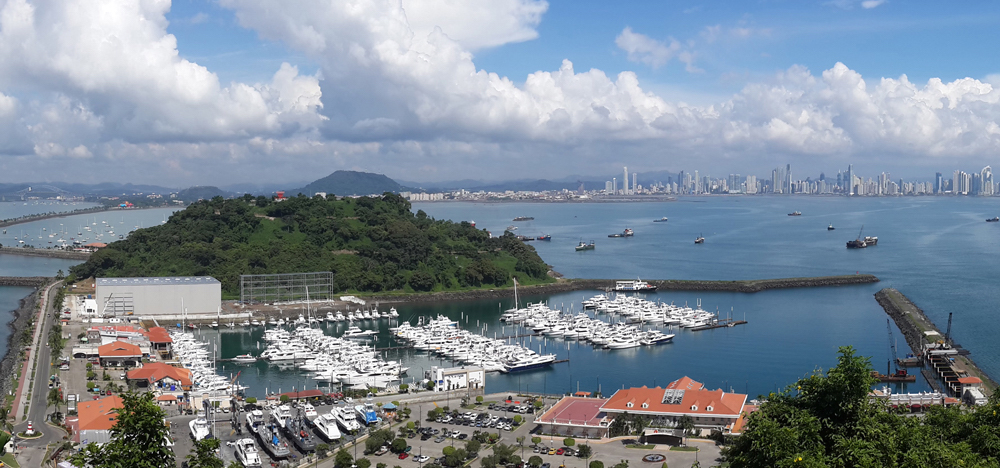
We could have explored the gleaming modern city that now bristles with unique architecture that just seemed so fantastic and futuristic. Until 2000 there were barely any tall buildings but construction has accelerated since and now there are nearly 200 buildings rising dramatically into the sky, including the JW Marriott looking like a massive sail unfurled in the wind and the F&F Tower or Revolution Tower, nicknamed the “Tornillo”, ‘screw’ in Spanish. Turns out we could see the Screw from the pool. We could also see from our pool La Iglesia De Carmen a beautiful church in a gothic style that is a popular visit with tourists. It was just around the corner from the hotel and we nodded in agreement that it was beautiful from our chaise lounges.

Revolution Towers in a store 

CEVICHE FOR ALL
We did manage to visit the Mercado de Mariscos earlier in the day. It is a sprawling, bustling fish market at the edge of Casco Viejo popular with local families, restaurateurs and tourists. Our driver suggested we stop. We had arranged for the ride through the cruise line and she picked us up at the Flamenco Marina on the Amador Causeway and after taking the Cinta Costera, a viaduct several hundred feet off shore that wound around the Casco Viejo peninsula which alleviated heavy traffic in the area and preserved the UNESCO World Heritage status, we parked curbside and entered a swirling world of just caught seafood.
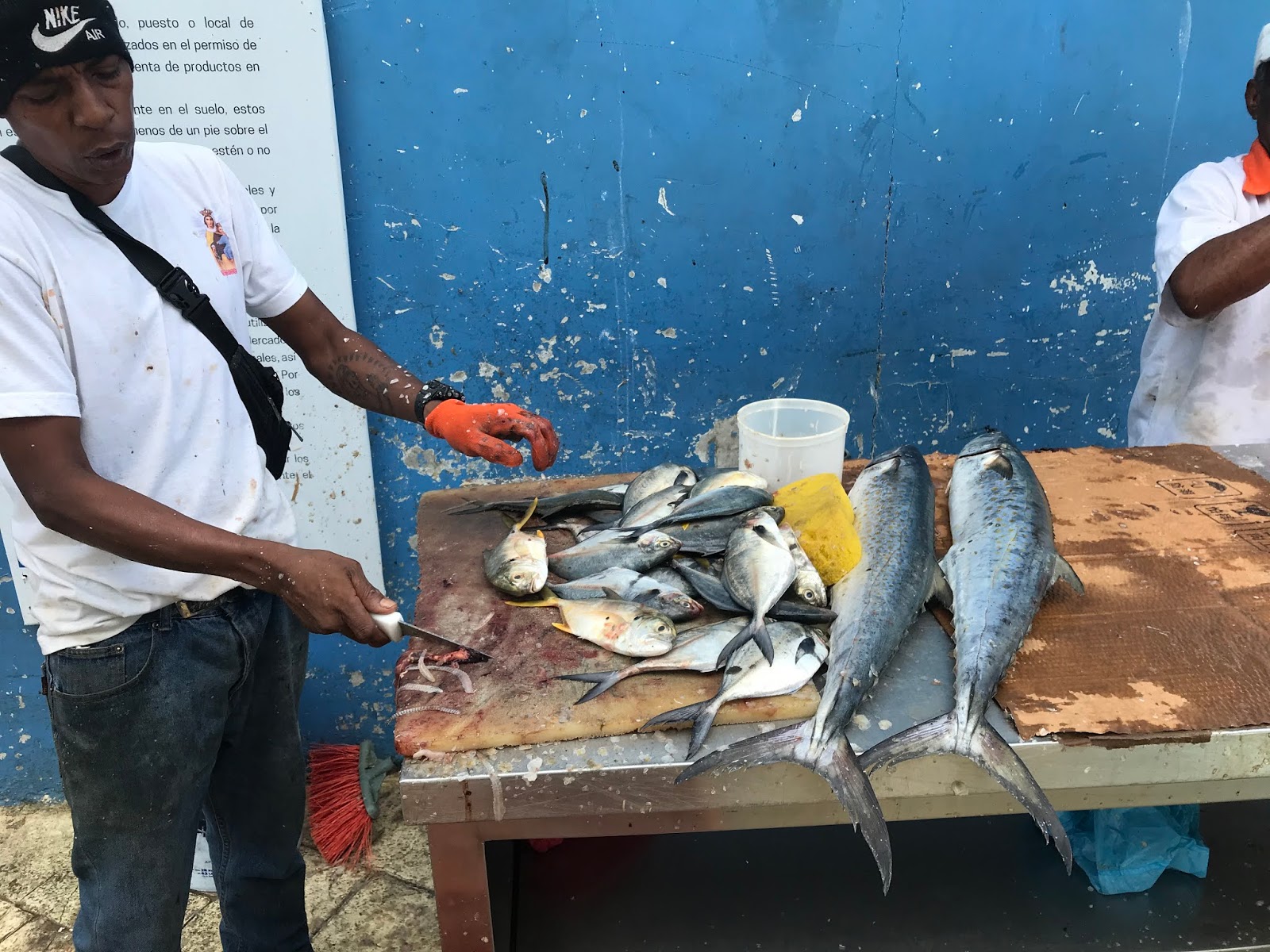
The market is right at the water’s edge and opens early in the morning. The fishing boats unload their haul and it doesn’t have to travel very far. There is an outside area where men are preparing the fish for the market and a vast interior area of dozens of stalls where one can buy by the pound everything from tuna and salmon to game fish like marlin, sailfish and wahoo. Shellfish and prawns are all for sale and everything is very inexpensive! We saw one fish called Atun Chico for $1.50 / lb. and some sort of shellfish for $2.00 / dozen.


Outside there are a number of food stalls and ceviche stands. It was too early in the day to have the little restaurants open, but our driver pointed out that ceviche is very cheap, and obviously very fresh in these little no-frills places. You can also order fries or patacones (fried plantain) which make for a great snack as you walk around. There is also a more formal dining area on the second floor where chefs will cook your purchase for you.


TINAJAS
It might have been a great adventure to return to the market for dinner later in the day, but we opted to stay close to the hotel. A couple who had also traveled on the Panorama met us at the hotel and we walked around the corner to Tinajas Restaurant. Tinajas serves typical Panamanian fare and several days a week there is a very entertaining show of Panamanian music and dancing on a small stage at one end of the restaurant. Given the food and the culture, Tinajas was an ideal place to end our trip.

There is great food at decent prices at Tinajas. There is a modest cover charge, for the folk dancing show, but it was worth it for the experience. Our typical Panamanian meals did not disappoint.  We split an appetizer of Patacones topped with Ropa Vieja and for her main Janet had Grilled Octopus and I had a whole Red Snapper grilled Caribbean-style. The best part of the evening was the show though. We were one of the first patrons that evening and the restaurant was empty, but by showtime, the place was packed.  

We were greeted at the door by a woman wearing a very ornate and colorful pollera, a long one-piece skirt used in traditional festivals. Her hair was festooned with a pearl headdress and her make-up was immaculate. She looked preternaturally perfect, like a Disney character. Later she proved to be one of the dancers in the show. Several other women in the show also wore pollera which they would proudly unfurl as they swirled around the dance floor with their partners who wore plain sackcloth clothes and hats.

Shows are Tuesday, Thursday, Friday and Saturday.

                                                                                             
CAUTIONARY TALE
This was our last stop in a last-minute trip. We had booked the cruise, flights and hotel stays in mid-December for a mid-February departure. Costa Rica and Panama was not on our original list as traveling destinations, but serendipity and chance came to our rescue. We were also very fortunate that the Covid-19 pandemic did not affect us while there or in our travels home. We were lucky that we were not stranded or have gotten sick before “social distancing” had become a standby approach to a healthy life.

Doing research for this final article I have seen how the pandemic has shuttered many places in Panama City. The Doubletree is listed as temporarily closed. The fish market has pandemic measures in place. Tinajas is currently closed.  

Please be smart. Safe travels.

Thanks for reading.

Love Janet and greg

© 2020 by GREG DUNAJ

Friday, May 29, 2020

PANAMA CITY AND CANAL


FROM BEATING DRUMS TO BUSTLING CITY
Our final full day of sailing in the Pacific Ocean along the Central American coasts of Costa Rica and Panama could not have been more serene. The M/S Panorama, sailing under the Greek flag with Variety Cruises, anchored off Playa Muerto in the Darien Province and there we were immersed in the Embera culture, an indigenous people previously unknown to us. After our tour we sailed for the Pearl Islands, for a final swim in the Pacific. A cluster of 200 islands and islets, many uninhabited, the Pearl Islands are 30 miles off the coast and have been a popular location for several seasons of the reality TV show Survivor.
 
EMBERA GIRL
Well, no one voted us off the boat and we ate our final dinner at sea and drank martinis as we watched the sun set, and when we finally retired to our berth the world was tranquil and peaceful and quiet.  Most of our sailing on this trip was at night and when we awoke this final day we had left behind a world of rainforests, exotic animals and indigenous people and arose to a world of commerce and commotion. We had moored at Flamenco Marina on the Amador Causeway in the capital, Panama City, our final destination

SO MUCH … SO LITTLE TIME!
Our travels along the Central American coast allowed us to experience some of the unique natural beauty of the area and now it was our chance to see how that nature had been changed for the benefit of man. Beyond the marina’s breakwater massive cargo ships were awaiting their chance to enter the Panama Canal and the skyline of a very modern looking Panama City glinted in the sunlight. It was surreal. As quiet and remote every other place in Panama had been for us, there was this jolt back to reality that most of the world is a tumult of activity and it is forever churning.

FLAMENCO MARINA WITH PANAMA CITY

We had one full day on the Panorama while docked at the marina before we had to disembark and we took a last guided tour offered by Variety Cruises. In the blistering heat of midday, we were herded into a van to see the Miraflores Locks of the Panama Canal and then a short tour of Casco Viejo Panama City. That was a lot to see in four hours. The magnitude and history of the Panama Canal alone was enough to inspire a second trip to the area and later a brief foray into the Old Quarter of Panama City left us wanting to do more.

THE BIG DIG
Admission to the Miraflores Locks visitor center and museum was included in our $80 tour fee and we crowded onto the topmost of the three terraces that looked down into the lock to watch a number of smaller ships pass at the same time. There were more people crowded into the visitor center to see this engineering marvel up close than we had seen throughout all of our travels in Panama. It was packed and space at the rail for an unobstructed view was rare.
 
OUR VIEW AT MIRAFLORES 
The water in the lock will raise, or lower, a ship approximately 27 feet, depending on the travel direction. Tolls for the Panama Canal are based on the ship’s weight. The average fee is around $150,000, but can be much more for the larger ships. 

Our tour guide told us to take an hour to watch the ships and then walk through the museum which was four floors of displays about the history and workings of the “BIG DIG”.  Little models of past equipment used were particularly fascinating as was the interactive facsimile of a cargo ship wheelhouse that showed the normally 8-to-10-hour trip through the canal in about 3 minutes on screens. Kids spun the wheel and honked the horn incessantly as the cargo ship zipped through the locks.
 
A NEO-PANAMAX SHIP
While at the Miraflores viewing terrace, we saw in the distance a massive Neo-Panamax cargo ship, nearly double the capacity previously allowed at the Miraflores Locks. This expansion of the Panama Canal system is sometimes called the “Third Set of Locks Project” and was completed in 2016 greatly improving the flow of ships through the canal. The massive ship seemingly slid along the ground easily. We could not see the locks from our great distance.

At this visitor center there was also an IMAX theater that was not included in our tour, and there were two gift shops; one in the museum and the other in the IMAX lobby. All the prices were listed in United States Dollars.
CLOSE UP OF MIRAFLORES LOCKS  

FENCE OF SHAME
Back in the van our guide pointed out buildings that were once part of the Panama Canal Zone administration, neglecting to speak of Martyr’s Day a day of mourning in the country. On January 9, 1964 anti-American riots over sovereignty of the Panama Canal Zone broke out when several students crossed the “fence of shame” to erect a Panamanian flag in the zone. The fence was a safety barrier along a busy highway that also served as the border between the zone and Panama. In the ensuing clashes a number of people were killed.

Another sight he pointed out was the Bridge of the America’s that crosses over the Panama Canal, connecting North and South America. It is part of the Pan-American Highway system and erected in 1962 and quickly became overcrowded with traffic. The Centennial Bridge meant to alleviate the bottleneck of this necessary roadway was completed in 2003, 9 miles north. We drove beneath the Bridge of the America’s on our way to the old city, Casco Viejo.
 
STREET CORNER EL CHORRILLO
NO MAS!
Casco Viejo means “old quarter” and it is a very popular tourist destination, but to get there we had to drive through a dubious neighborhood. Our guide said we would find the best Panamanian food here in El Chorrillo, but it would be wise to get it “to go”. Once street gangs ruled the streets of this area, filling a vacuum in the illegal drug market created when Manuel Noriega was ousted in Operation Just Cause in 1989. Noriega was from el Chorrillo and his neighborhood was mercilessly bombed in the United States invasion. For years the gangs controlled El Chorrillo and though they are still a presence, many gang members work in the tourism industry as guides. Another notable resident from this still impoverished neighborhood is the actor Ruben Blades and the "Hands of Stone" Panamanian boxer Roberto Duran was raised here.  


CASTILLIA DEL ORO
Panama City was the first permanent European settlement on the Pacific coast. Established in 1519 and known originally as Castillia del Oro, the city quickly became the launching point for many expeditions including the plundering of gold and silver in Peru by the Spanish. By 1671 there were over 10,000 inhabitants of Panama City when it was attacked and razed by the pirate Henry Morgan. The ruins of Panama Viejo remain as a popular tourist attraction, but on our short tour we traveled only to Casco Viejo (Old Quarter).

STREET SCENE CASCO VIEJO

When Panama City was rebuilt a few years after Morgan’s attack the city was relocated here, on a peninsula. Today the official name of this section of town is called San Felipe but commonly called Casco Viejo. It is a few miles southwest of the original Panama City site. This old colonial area of narrow winding streets was declared a World Heritage site in 1997 and t is a popular tourist destination of shops, trendy boutique hotels, tapas bars and nightclubs. The architecture is old Spanish and French colonial buildings, many now renovated to their original splendor. The area is quite beautiful, but we did not have a lot of time to explore there.
 
GOLDEN ALTAR
The van dropped us off at the Church of San Jose home to a golden altar that escaped the plundering of Morgan and his pirates through the chicanery of a priest who painted it black. Eventually the gold leaf altar was transported to Casco Viejo. It was a popular stop for many tourists and we were elbow to elbow admiring the ornate altar. Next on our mini-tour was a short walk to the lovely Independence Square where we had 20 minutes to step inside the magnificent Panama Metropolitan Cathedral. We ignored the café just across the street; we had no time.

Afterwards we briefly stopped in a Panama Hat store and then stopped by the famed ruins of el Arco Chato, the flat arch that swayed the Americans into keeping the canal in Panama. Erected in 1678 as the Santo Domingo convent, the building was ravaged by two fires which toppled the tower and the interior walls, but the exterior walls and the arch remained. When the United States was pondering Nicaragua as a place to dig a canal, the very presence of this arch standing for hundreds of years proved there was no excess seismic activity and the area deemed more stable for such a massive project like the canal.
 
EL ARCO CHATO
Our final stop on this woefully short excursion was at the Plaza de Francia which commemorates France’s failed attempt at digging the canal. The economic losses for France were in the billions, but it is estimated that 22,000 human souls were lost while France tried to cross the isthmus, including 10,000 French laborers. Many died from accidents but most from diseases like malaria and yellow fever. The beautiful plaza was erected as a tribute to those lost in this monumental effort. We mounted the stairs that circled an obelisk that had a French Rooster atop it and walked the promenade where there were a lot of merchants selling tourist items like t shirts and key chains and colorful molas, the cloth artwork fashioned by the indigenous Kuna people. Ahead was the gleaming modern Panama City glinting in the sunlight and to our right was the Cinta Costera an odd beltway that connects the Pan-American highway with the rest of Panama City, alleviating traffic and preserving the World Heritage status of Casco Viejo.
 
METROPOLITAN CATHEDRAL
MAS?
That was it for our tour. After milling about the merchant stands for a while the van picked us up and brought us back to the Panorama. We were left wanting more time to explore this area of the city.

Thanks for reading.

Love Janet and greg


FRENCH PLAZA PANAMA CITY
Here is a link to a webcam of the Miraflores locks.
MIRAFLORES LOCKS, PANAMA CANAL, WEBCAM

© 2020 by GREG DUNAJ