Showing posts with label PANAMA. Show all posts

Wednesday, May 13, 2020

I’LL SEE YOUR BALBOA AND RAISE YOU A DOLLAR

PANAMA MONEY
The country of Panama is complicated and then it isn’t. It became a country in 1903 when it broke away from Colombia with the “help” of the United States, which was employing its Teddy Roosevelt “Big-Stick” diplomacy to get what it wanted, which was to finally complete the Panama Canal. The idea had been kicked around since 1513 when Vasco Nunez de Balboa “discovered” the Pacific Ocean and the latest endeavor by the French failed miserably in 1889 because of the high cost in lives and money.  

The need for a canal across the Panamanian isthmus became very pressing to Roosevelt and the United States when in 1898 on the eve of the Spanish-American War, the USS Oregon, the most powerful warship at the time, was stuck in San Francisco and it took her over two months at full speed to circumnavigate South America and reach Cuba. 

With some political shenanigans, well-placed fake news in the papers, a warship off the coast of Colombia and a whole lot of American Dinero to Panama and Colombia the U.S. got what it wanted and basically “took” Panama for themselves, or at least the part called the Panama Canal Zone.

Beyond the Panama Canal and the capital, Panama City, life in Panama is a lot quieter; brimming with rainforests populated by native cultures; or at least what we were fortunate to see while on a recent visit there in February. Approximately 43% of the country remains forested and despite the dubious history of the canal, a couple of coups and brutal dictatorships, the country now seems easy and uncomplicated and stable.

YO, ADRIAN
Aiding in that stability is the monetary system of Panama. Money in Panama is complicated, but then it isn’t. Since 1903, Panama has been infused with American dollars as the U.S. sought to secure the rights to dig the Panama Canal. Since then the American Dollar is the legal tender of Panama, although at the same time, Panama also created their own currency called the Balboa. No, it’s not named after that boxer from Philadelphia. Like the Dollar, the Balboa is divided into 100 cents or centesimos and the PAB is broken up in denomination coins similar to the USD: 1, 5, 10, 25, 50. The Balboa though stops at 1. Beyond a single Balboa the money is all American banknotes.  

1 PAB

There is no central bank in Panama and usually a country will issue their own currency to “influence” the economy. By regulating the influx of the money supply, interest rates are controlled and money is created when needed. i.e. out of thin air.  But, because Panama has no central bank it has no control on the economy. The PAB is tied to the stability of the USD at 1:1 which means you can pay for your $10.00 McDonald’s meal in Panama City with a $5.00 bill, 2 $1.00 bills, 2 1 Balboas AND a fistful of smaller coins. Hand over a $20.00 bill for a snack of 
Carimaňolas (stuffed yucca fritters) and a Balboa beer, you’ll get back a collection of Balboa coins, but no USD. It's a smooth economic situation.....

In 1941 then President Arias of Panama attempted to gum up the works and start a central bank and issue 6 million Balboas worth of Panamanian paper money. That lasted 7 days. He was overthrown in a U.S. backed military coup and the bank was closed, all the issued paper Balboas were confiscated and destroyed and Panama went back to a smooth economic situation.

The best part about this is that the Balboa, tied to the Dollar, will always look good, not like Rocky Balboa in his bout with Apollo Creed.


I told you it was complicated.

Thanks for reading. 


© 2020 by Greg Dunaj  


Friday, May 8, 2020

PLAYA MUERTO AND THE EMBERA-WOUNAAN

INDIGENOUS PEOPLE OF PANAMA
Before the Coronavirus Pandemic, life for Team VFH was merrily, merrily, merrily sailing along the Pacific coast of Central America and we were fortunate to visit Playa Muerto. A modest settlement of the Embera and Wounaan, two indigenous people of Panama, is at this remote area on the Pacific coast of southeastern Panama. 

Before there was a Panama or a Colombia, the Embera and the Wounaan lived in the tropical rainforest that is now known as Darien National Park. This massive, protected area forms almost the entire border with Colombia and is so thick and impassable that the Pan-American Highway, that starts in Alaska, and ends in southern Argentina, is interrupted by this UNESCO World Heritage Site. 

Darien Provence is one of the largest and most protected areas in all of Central America and sparsely populated. For hundreds of years, the Embera and the Wounaan, two culturally similar people, but speaking different languages, lived a semi-nomadic life of slash-and-burn subsistence farming and hunting in this rainforest. At times they would log valuable timber which they converted into hard currency. All of this has been stopped or is now severely limited because of the Darien’s protected status.


Conversely, the Embera, Wounaan and other native people like the Kuna are impoverished and alarmingly their unique cultures were dissipating with emigration out of the Darien Provence to the modernized areas of Panama. Indigenous rites, traditions and even native languages were slowly being lost.

ECO-TOURISM TO THE RESCUE
Cultural tourism has proved to be extremely helpful in saving the uniqueness of these native people. After creating Darian National Park, the Panamanian government realized that the culture and art of her native tribes was as valuable as the tropical rainforest and helped start a modest tourism project to save these cultures from extinction. The idea though welcomed by the Embera-Wounaan was difficult to implement at first and started very slowly. After all, Playa Muerto is very remote. There are no roads leading here and though hiking in with a guide is feasible; a tourist can make arrangements to spend the night at Playa Muerto; the only reliable way here is by boat.


Sadly, it was a long time before cruise ships like the M/S Panorama began stopping there and the fate of the Embera and Wounaan people suffered. Despite being open to tourism, there were no tourists and no income. Impoverished families began to move away from Playa Muerto again.

It is remarkable how much the community at Playa Muerto benefits from visits like ours. Just three visits a year from a small cruise ship like the M/S Panorama provides the Embera-Wounaan with enough income to sustain themselves, but most importantly it also inspires them to revive traditions like dancing and body painting and handicrafts. Visits like ours have brought Playa Muerto, literally, Dead Beach, back to life. The Embera and Wounaan who live in this area number approximately 200 and theirs is a simple, sustainable, harmonious place and well worth the effort to get there.


EMBERA-WOUNAAN v. KUNA
Our 6-hour immersion into another way of living began when a sturdy wooden boat from the village picked us up at the M/S Panorama and sped us to the black sand beach, timing the Pacific waves so we’d land between curls. It was still a ‘wet’ landing and we had to wade to shore in shin deep water. The beach was beautiful, but desolate. The jungle came right up to the sand and as we waited for the Embera to greet us there was an ominous glowering, untamed quality to it all. Leaning in and murmuring to Janet I assured her the Embera were not cannibals.


Emerging from the jungle two Panamanian rangers or soldiers, they were wearing uniforms, stood off to the side as our guide spoke about the people of Playa Muerto. He told us that they originated from the Choco region of Colombia and the Embera were closely linked to the Wounaan tribe; both culturally the same but speaking different languages. We were told the Embera were the sworn enemies of the Kuna tribe, that they once battled each other hundreds of years ago but that today the conflicts were really about the tourism trade and the dollars they bring. Many of the Kuna live on the Caribbean side of Panama.


Each of these tribes create beautiful handicrafts, which they sell to visitors. The Embera and Wounaan weave beautiful colorful baskets called canasta that are so tightly woven they could hold water and also fashion carvings of animals from the tropical hardwood cocobolo. Both are sold in Panama City and at the airport, but here at Playa Muerto they are much cheaper. At the end of our tour the villagers gathered around with their wares displayed for purchase.

The Kuna are famous for colorful hand-made textiles called Mola. Several layers of cloth are sewn together and a design is formed when parts of each layer are cut away. Later in Panama City we were able to purchase several place-mat sized mola from a Kuna street-vendor


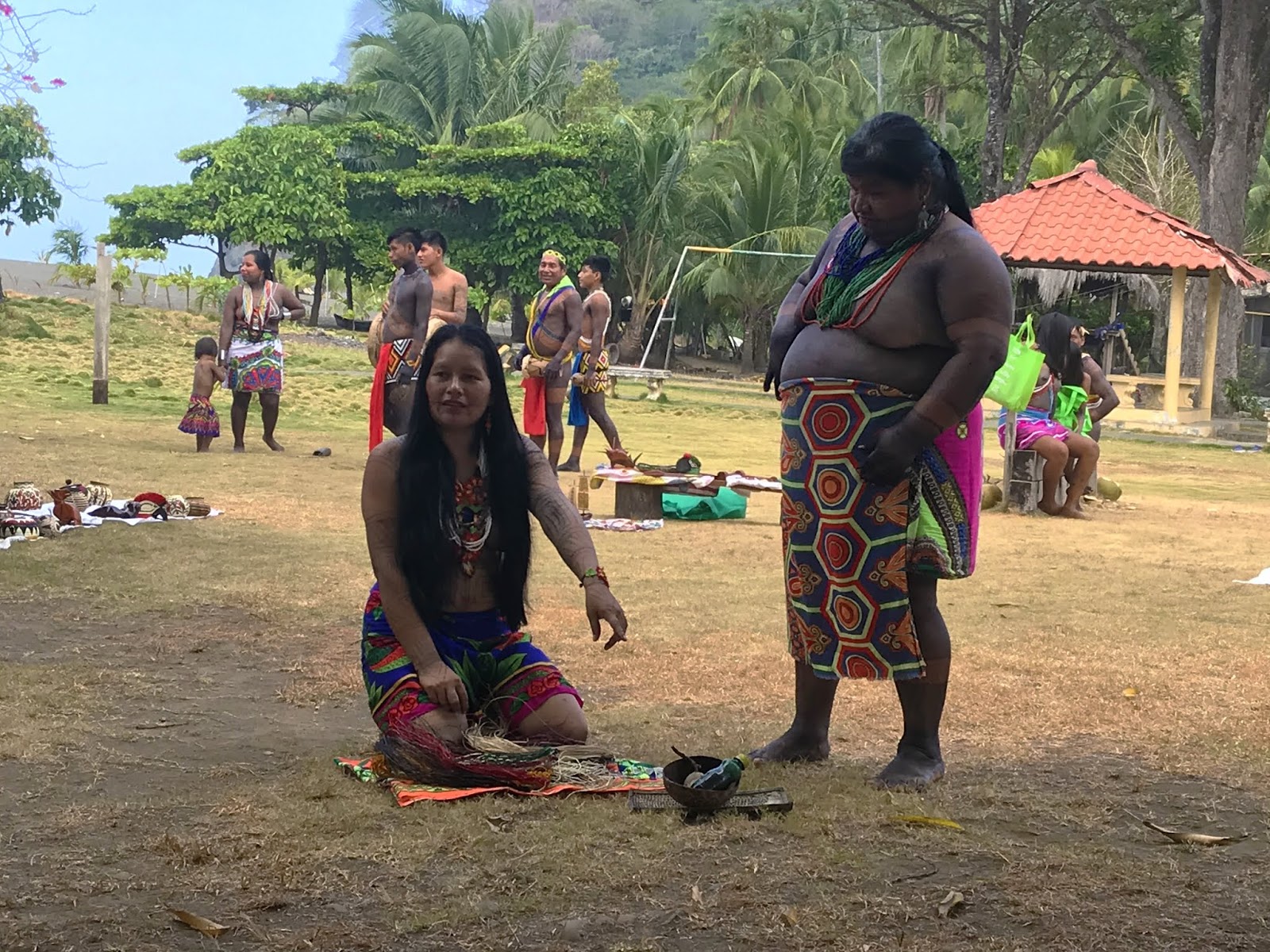
Our guide described the Embera-Wounaan as very short people and the women traditionally went topless while in their village and draped colorful strands of beads around the neck and wore brightly patterned cloths around their waists. They wore their coarse straight black hair long while the men had their hair cropped in a bowl shape and wore red loin cloths around their waists. Everyone, even the children, had tattoos made from the black dye of the Jagua fruit. For special occasions, like the M/S Panorama dropping by Playa Muerto for a visit, the Embera-Wounaan decorate their skin from the waist up in different geometric patterns. The dye is painted on their skin and lasts for a few days. Guests to Playa Muerto can also get Jagua “tattoos”.

PASS THE PATTACONES
A number of Embera women and children greeted us on the beach and we lingered there waiting for the men. All were dressed in native costume, but one of the girls also wore a modern backpack, a reminder that although this was a display of Embera-Wounaan traditions, these people were not living in the stone-age. (Hence the motor launch that picked us up from the Panorama).

I learned later that the colorful beaded necklaces were plastic, although many wore wide silver bracelets around their wrists and ankles. Some of the women wore earrings.   The beautiful colorful skirts the women wore were not created by the Embera but were from dyed cotton fabrics imported from south-east Asia. The Embera originally made their skirts from palm fibers. Though they could speak their native tongues they also spoke Spanish, and this native way of dress is replaced by pants and shirts when they go into modernized areas of the country. Later as we strolled the village of open walled houses built on stilts, I saw a number of people in western dress and shorts. Long heavy pants are impractical in the heat and humidity of Playa Muerto.

So, on this day at Playa Muerto there was a theme park quality to it all, that the Embera and Wounaan were playing dress up for our entertainment. I was reminded of the Old Lahaina Luau that we attended on Maui a few years back. At the time I was at first embarrassed for the native Hawaiians playing dress-up for the “haoles”, and where “Pass the Poi,” was heard often at the meal, but I quickly realized the Hawaiians, like the Embera and the Wounaans here in Panama, were proud of their heritage.

Tourism instills a sense of pride for the people of the Darien and encourages them to maintain their traditions, cultures and languages. Rather than being ignored or forgotten the Embera now realize there are people from all over the world that are interested in their way of life. Just on our little passenger ship, there were people from Canada, Australia, England, France, the Czech Republic and the United States.   

SAFETY DANCE
Typical of Embera celebrations, we were welcomed by several musicians playing percussion instruments and flutes and were led off the beach to a hill where we saw a demonstration of milling corn and squeezing sugar cane. All the while we were encouraged to photograph the Embera. The rangers trailed discreetly behind our entourage. I saw a fresh print of a large cat in the mud not far from where the demonstration was going on and went back to photograph it. The rangers confirmed it was a Jaguar footprint. I had then the sneaky suspicion that the musicians not only “greeted” us, but also served to alert any critters to get away.
One stark difference between Playa Muerto and the Old Lahaina Luau is that this place is real.  In Lahaina there was a stage and we parked our rentals in a nearby shopping mall. Playa Muerto was a jungle and these Embera and Wounaan were people living in the jungle with all of this nature surrounding them. They lived this way, and we were fortunate to see some of their daily life.

After the demonstrations on the hill, we walked to a waterfall to swim in the cold refreshing water before we were led down to the village which was really just a collection of scattered homes with a large communal hut in the middle. All the homes were built high on stilts, several feet off the ground. Traditionally this was to offer protection from wild animals and to avoid flooding during the rainy season. To catch cooling breezes homes are often built with just one or two walls, with the rest open.

At the communal hut we were seated, fed fish and rice, and entertained by Embera dances and music. Afterwards seemingly everyone from Playa Muerto came to sell their handicrafts. Sitting on the ground with blankets the villagers displayed their baskets and carvings and we bought a basket for $30. Later at the airport we saw a similar one for $100.

MAINTAINING A LIFESTYLE
Beyond this communal area, life at Playa Muerto gets more modern. It was like stepping through a portal in time. Over here topless women are pounding corn with a massive mortar and pestle and men wearing nothing but red loin cloths beat drums, and over there is a soccer pitch, a playground with a swing set and jungle gym, a macadam basketball court and a rustic school built by the government that really seemed out of place here.

Panama requires all children to attend 6 years of school; beyond that education is expensive and requires travel away from Playa Muerto, another cost subsidized by the eco-tourism.

Another modern convenience was a commissary that sold cigarettes and beer and foodstuffs, and where personal device batteries can be recharged for a few cents. The only lights in the village are solar battery-powered although they have a gas generator to power lights when necessary. The village of Playa Muerto even has its own Facebook page, where videos of dance parties and photos of players in a sports tournament are displayed!

Because Playa Muerto is very remote only a handful of visitors come each year and so the tourism of the community is very basic. Still, the revenue generated keeps the Embera and Wounaan cultures alive and prevents them from being fully assimilated.
As we waited in the Embera boat for the right waves to launch from shore back to the Panorama villagers came to play a final time for us. A few girls danced; their colorful skirts brilliant against the black sand.

I was struck by the friendliness and overall happiness of the people. They seemed very proud of their culture and pleased we were here to visit them as if it was as pleasurable for them as it was informative for us. But, the allure of Playa Muerto is not just with the Embera, but the beauty of the land and her remote location. We were only there for a half day shore excursion, but it is possible to stay longer.

A few years ago, as an effort to maintain revenue streams for the community, three bungalows were built for lengthier stays. Amenities are spare but clean and comfortable. The bungalows are maintained by the locals 100% of the money stays within the community.

For reservations and inquiries, go here… (just make sure you speak Spanish) :
THANKS FOR COMING
The hardest part about seeing Playa Muerto on your own without a small cruise like ours is getting there. It’s either a tough two-day hike through the jungle or a long, expensive and uncomfortable boat ride, but you’ll be rewarded by a pristine paradise of incredible beauty and the brilliant smiling faces of the Embera and Wounaan. They will truly be happy to see you.

The Playa Muerto website gives tips on how to get there as an individual, but they also recommend Ancon Expeditions. Here is their website:

Thanks for reading. Panama has proved to be an incredibly beautiful, diverse country.

My pictures don't portray Playa Muerto as well as their gallery.... Here's a link to more pictures: PLAYA MUERTO PHOTO GALLERY

© 2020 by Greg Dunaj


Wednesday, April 15, 2020

PANAMA and IGUANA ISLAND

ISTHMUS BE MY LUCKY DAY
The history of Panama is somewhat complicated, although while waiting on the Playa El Cirial a beautiful long white sandy stretch on Iguana Island off the eastern coast of the Azuero Peninsula, it certainly seemed tranquil enough. The water was placid, the sky azure. It was hot though and a languid breeze did not cool us as we sat in the shade. Hundreds of hermit crabs did a cha cha along the sand and we busied ourselves ogling them as we waited and sweated and waited some more.
 
Keeping Iguana Island safe
Though the water was inviting we were told not to venture from our shady spot. We were waiting for the Panamanian Public Forces to finish checking our paperwork.

The Greek crewman, who spoke no Spanish, had piloted the zodiac tender to shore and was challenged there by a ranger. There was a bit of shoulder shrugging and it took a good while to clear things up. Ominously, as we waited, a Panamanian patrol boat with several men wearing balaclavas and flak jackets and carrying guns pulled up to join the party. Costa Rica abolished her military after a bloody civil war in 1948. Panama also abolished its standing army after the United States' Operation 'Just Cause' overthrew the military dictatorship of Manuel Noriega in 1989, but the country still maintains a small air and maritime force.

This is MY island

It was supposed to be a simple relaxing day of swimming and snorkeling at the Iguana Island Wildlife Refuge, in the morning and afternoon, with a quick trip to the M/S Panorama for lunch in between, but the morning was taken up by the logistics of travel. There was just enough time to walk to the other side of the island to see the frigate nesting site, before it was time for lunch.

BOMBS AWAY
Dodging spiders and iguanas and ever mindful to not deviate from the trail lest we find some ordnance left over from World War II when the U.S. military used Iguana island for target practice, we crossed the island to see the frigate colony and admire the surf at the secluded El Faro beach near there, before heading back to Cirial and then back to the Panorama. Indeed, one highlight of our little hike, the island is just 136 acres, was to peer into a massive bomb crater.


IDYLLIC TODAY
As I waited my turn for the tender to return to the Panorama, I stepped into the ankle-deep water to watch pufferfish lazily swim in the coral just below the water’s surface and several little red fish swirled around my feet looking for some nutrients I disturbed with my steps. The water was very clear and felt, despite the bomb crater and that history, all very untamed and unspoiled. Though Panama has the canal, over 40% of the country is still rainforest. Much of the population is concentrated near the canal, leaving places like Coiba Island and Iguana Island largely alone and rural.


Iguana Island is considered the top snorkeling spot in Panama and later that afternoon some of us were dropped off to enjoy the water and the views. It took all day to get to swim, but it was worth it. I came away feeling fortunate I was able to see Iguana Island. There is no way I would have found this place on my own without our guide and though I might have wanted to lounge about more on Cirial I know those hermit crabs would have the last say on that.
Iguana Island & M/S Panorama 


Tourism is growing in Panama and maybe the quiet serenity of places like Iguana Island may not survive. The government offers tax and price discounts to foreign travelers and retirees and the number of venders offering tourist destinations have steadily increased over the years with these visitor incentives. Actively pushing tourism and the income it generates it now accounts for roughly 9% of Panama’s GNP.  

I’m glad we were able to visit Panama now.

Thanks for reading.


© 2020 by Greg Dunaj


Wearing an official Vacations From Home t-shirt

Saturday, April 11, 2020

PANAMA and COIBA ISLAND

THE BIG DIG, DAVID LEE ROTH and MARIANO RIVERA
As a travel destination Panama was never on my radar, and for that matter neither was Costa Rica. All I knew about Panama was the canal, the song from Van Halen, which was really about a stripper, and a vague recollection that the Hall of Fame pitcher Mariano Rivera of the New York Yankees was Panamanian.

Well, this sailing adventure along the Pacific coast of Central America had proved to be a lovely surprise for the Costa Rican part of the trip. The beauty of the land, the biodiversity of the birds, animals and plants, the black sand beaches, the coffee and the Cacique had made Costa Rica an unexpectedly delightful visit. Topping those experiences in nearby Panama would only be possible if I got a chance to play catch with Mariano, or so I thought. Panama proved to be as worthy a destination with its own set of beauty and experiences.

HOW DID I GET HERE?
Serendipity and chance were very kind to us on this trip, because we simply followed a deal without any preferred destination, and we were rewarded handsomely. We just wanted to be somewhere warm in February.

We booked this trip in mid-December for a mid-February departure through Unforgettable Cruises, which is effectively last minute. Revenue is forever lost whenever a ship leaves port with empty berths, and we had seen the half-price special offered on their website. We had sailed with Unforgettable Cruises in Croatia last summer and the level of comfort and the range of experiences had us coming back. Turns out Unforgettable was helping another small yacht company Variety Cruises in the booking, but there was no drop off in care or comfort. In fact, with Variety we were alone on the Pacific, whereas our July trip in Croatia was a somewhat crowded race up the Adriatic with several other cruise lines plying the waters.

Good Advice:
Always check the specials offered by Unforgettable Cruises, and Variety Cruises, the two companies we traveled with this past year. You’ll never know where you’ll end up.


WHERE AM I?
Our last stop in Costa Rica was at Corcovado National Park, but before the M/S Panorama could leave for Panama, she had to rendezvous with customs and immigrations officials coming out of Golfito to pay an “exit clearance fee” and to check passenger and crew lists. At the time I thought this was out of the ordinary because of the Coronavirus pandemic that was just starting to spread, but was assured that although immigration officials could demand a full-face control of passenger and crew against passports, they just randomly checked the paperwork and paid the fee. This was normal procedure and not related to Covid19.

Once the ship pays its “exit clearance fee” she is not allowed to call on any other Costa Rican port or territory and must sail away.

Incidentally Costa Rica does require an “exit fax” whether flying out of the country or crossing the border overland. The airport fee is $29 usd or the equivalent in colones and this is usually included in your airline ticket. Check beforehand to avoid confusion at departure. The fee for crossing into Nicaragua or Panama by land is $7.00.

Here is the US State Department’s website on the exit tax:

TO HELL AND BACK
By 9 am we were still sailing for Coiba island, the largest of the 38 islands in the 430.000-acre Coiba National Park, a UNESCO World Heritage Site since 2005. The beautiful and isolated Coiba Island is the largest island in all of Central America and has remained pristine and untouched from human contact. According to UNESCO Coiba’s Pacific Tropical rainforest maintains an exceptionally high levels of endemic animals, plants and birds because of “the ongoing evolution of NEW SPECIES” and is the last refuge of many rare and threatened animals that have disappeared from the rest of Panama like the crested eagle and the scarlet macaw. Abundant marine life in the park includes over 700 fish species, 33 shark species like hammerhead and whale sharks, the largest fish that can approach 20 meters in length, and 20 different species of marine mammals, like dolphins, orcas and humpback whales.
COIBA ISLAND PANAMA

The isolation and subsequently the conservation of Coiba Island proper has a dark history. Once a notorious penal colony Coiba was Panama’s version of Devil’s Island, the infamous French prison island off the French Guiana coast. The prison operated from 1919 to 2004 under deplorable conditions. The most dangerous felons and enemies of the state were sent there, some to cells and others to live in camps where groups of men fended for themselves by farming and ranching the land. Some men were sent to Coiba for a specified time, others stayed until they died. Stories of torture and of mass graves and dismembered bodies being fed to sharks still persist as Coiba was home to “Los Desaparecidos”, ‘the Disappeared’ during the dictatorships of Omar Torrijos and Manuel Noreiga. Hundreds perhaps thousands of political prisoners were dumped on Coiba, never to be heard from again.

This dark history of Panama has actually preserved the natural isolated beauty of Coiba and has flourished because many Panamanians, tourists and developers fearful of this dark place have stayed away after the prison was shuttered. Except for the crumbling structures of the penal colony, slowly being reclaimed by the jungle, much of the island is untouched. Today access to the park is highly restricted and accessible only by permits issued by the woefully underfunded Autoridad Nacional del Ambeinte or ANAM. The rangers’ task is daunting; to supervise the vast area and to protect if from poachers and illegal tree logging. 
 
VIEW FROM COIBA ISLAND
The ANAM maintains a small ranger station on the north side of the island where we finally spent a relaxing day on the beach and hiking around the immediate area including up a steep hill where we were rewarded by a beautiful view of the nearby islands of Coiba National Park. At the station there are several modest two-room cabins, with air conditioning, for overnight stays. Tour operators from the mainland offer ecotours, fishing, scuba diving and snorkeling trips and we watched several such groups come ashore to have lunch in the small pavilion. The crew of the Panorama also came ashore to provide us a Greek BBQ lunch.  Variety Cruises is a Greek enterprise.

ECOTOURISM?
Part of the allure of Coiba National Park is that it is possible to see whale sharks. The season to see these massive, but docile fish as they migrate through Coiba’s waters runs from January to April. Whale sharks often swim near the surface with their massive mouths wide open to capture the plankton they eat. Some tour groups offer scuba diving for around $150 or snorkeling trips for around $30 to see the whale sharks that feed near the islands of Coiba at this time. Usually the tour operators operate out of the fishing village of Santa Catalina on the mainland.
JUVENILE WHALE SHARK

Sadly, these beautiful endangered creatures are sought after for their fins, meat, and oil and according to the WWF even shark tourism presents a threat as it can interrupt their feeding. Because of their massive size these rarely seen gentle giants travel great distances in search of plankton and where the whale shark shows up is a good indicator of the health of the ocean. 

A few years ago, scientists tagged a whale shark, and she was recorded as having made an incredible migration journey of 12,000 miles. It was tagged in Coiba’s waters and eventually ended up near the Philippines. You can read that story here:

After our very satisfying and filling lunch we headed to a small beach on another nearby island to snorkel. Our little group was the only one there. The coral was beautiful and I followed a sea turtle for a while. He allowed me to keep up with him for a while as he kept looking over his shoulder at me before losing interest and gliding away effortlessly.


After dinner on the Panorama I decided to smoke a cigar, I had one left over from our stop in Quepos, Costa Rica and as I lingered over my martini I was joined by a number of other passengers as well as a flock (?) of beautiful moths that hitched a ride through the night This was a beautiful trip and a fantastic first day in Panama..

Thanks for reading. I guess I can’t say Pura Vida any longer because we no longer were in Costa Rica, but that serene feeling remains. 

SMALL SHIP PANORAMA COMES UP BIG
I would be remiss if I did not give a special nod to the crew of the M/S Panorama. We are safe at home now, but the crew of the Panorama are still out there and recently came to the rescue of Cuban crew members who were stranded because of the global pandemic and repatriated them to Havana. The Panorama was refueling in Barbados ahead of a transatlantic crossing returning to Greece when they learned 19 healthy crew members of the MSC Preziosa, a supersized cruise ship, were stranded with no appreciable way of getting home. Variety Cruises accepted a request from the Cuban government to repatriate the healthy crew, a seven day journey in the opposite direction from home. Cuba paid for the fuel, but Variety asked for no other compensation. It's an incredible story of kindness in this new normal we are living through. 

In case you're wondering. I never saw Van Halen in concert, but I did run into David Lee Roth at a Bottom Line show in NYC. He was drunk. 

Our version of Panama is much better.


LIVE LOVE TRAVEL 


© 2020 by Greg Dunaj

Saturday, March 14, 2020

SMALL SHIP SAILING


SELF QUARANTINING  
With Covid19 causing such a panic throughout the world we here at Vacations From Home are happy to be home, safe and symptoms free. We certainly enjoy flitting about the world, but currently we are doing what we all need to be doing, which is keeping your distance from others, drinking lots of fluids, washing your hands frequently and lastly avoid touching your face.

CONVID19

Like modern day Decameron hostages awaiting the Black Plague we have been minimizing our visits to the outside world.

Well, that’s a bit extreme, but we here at VFH central command feel fortunate. Having just returned from a sailing adventure from Costa Rica to Panama, we feel good, not sick. We’re in pretty good shape, and that prognosis is nothing to sneeze at. But, imagine our horror with all the recent news about those massive cruise ships, which are effectively floating petri dishes being quarantined, with some getting sick and some dying. This is serious shit.
 
M/S Panorama
SERENDIPITY AND CHANCE
Considering all the grief going on in the world now, we were quite lucky. We traveled on another small ship along the Pacific coast of Central America and we largely had the ship to ourselves. The M/S Panorama is with Variety Cruises, a Greek company. The Panorama winters here off the coasts of these two beautiful countries before eventually heading home to Greece for the summer sailing season. With a passenger capacity of 49 and a crew of 18 we were able to book our trip when there were only 16 passengers.  Yes, there were more crew than there were passengers! Although the week prior to our trip the Panorama carried 49 passengers and the week afterwards there was evidently a whole mess of birdwatchers coming in from Sweden, our week in paradise was empty. 

We booked passage on the Panorama last minute, i.e. just two months in advance, and we did it through Unforgettable Cruises, whom we sailed with in Croatia last July. And, we got it at half price. Variety Cruises was running out of time and approached Unforgettable to find passengers. Remember, when a ship sails with empty berths it is money lost forever.

M/S Panorama dining room

SIZE MATTERS
Now, the best part of a small ship is the level of attention given to the ship and to her passengers. Obviously, our trip was a unique situation, but a small ship is still safer to maintain with smaller areas on board to apply enhanced sanitation and disinfection procedures. Smaller passenger lists mean a more precautionary measure of hygiene on tour groups. This is on top of the intimate feel of smaller ships getting into ports where those petri dish behemoths can never. It is a more relaxed and intimate journey.

Before we were allowed to board the Panorama, we were given a questionnaire about our travels and if we had been to China, etc. within a certain time frame. I don’t believe we would have been allowed on the ship if we were just flying in from Wuhan, and I understand that on top of that the Variety people are now giving all embarking crew and passengers non-touch temperature screenings before they can board. On a massive cruise ship this is a logistical nightmare, but for the Variety Cruise people it was just another step in their rigorous standards of safety and cleanliness.

COMPARING APPLES TO APPLES
Since we traveled on two different small cruise lines within a year, I want to take this time to show the differences between our experiences, each unique.

We were spoiled by the level of opulence on the M/V Infinity with Unforgettable Cruises. Marbled bathroom floors and a very spacious stateroom though it was on the lower floor. We had the same room on the Panorama, at the bow of the ship, and it was a bit cramped and not marbled, but this is after all a sailing ship not a yacht. The room was still comfortable even if Janet and I had to breathe in unison to fit.
 
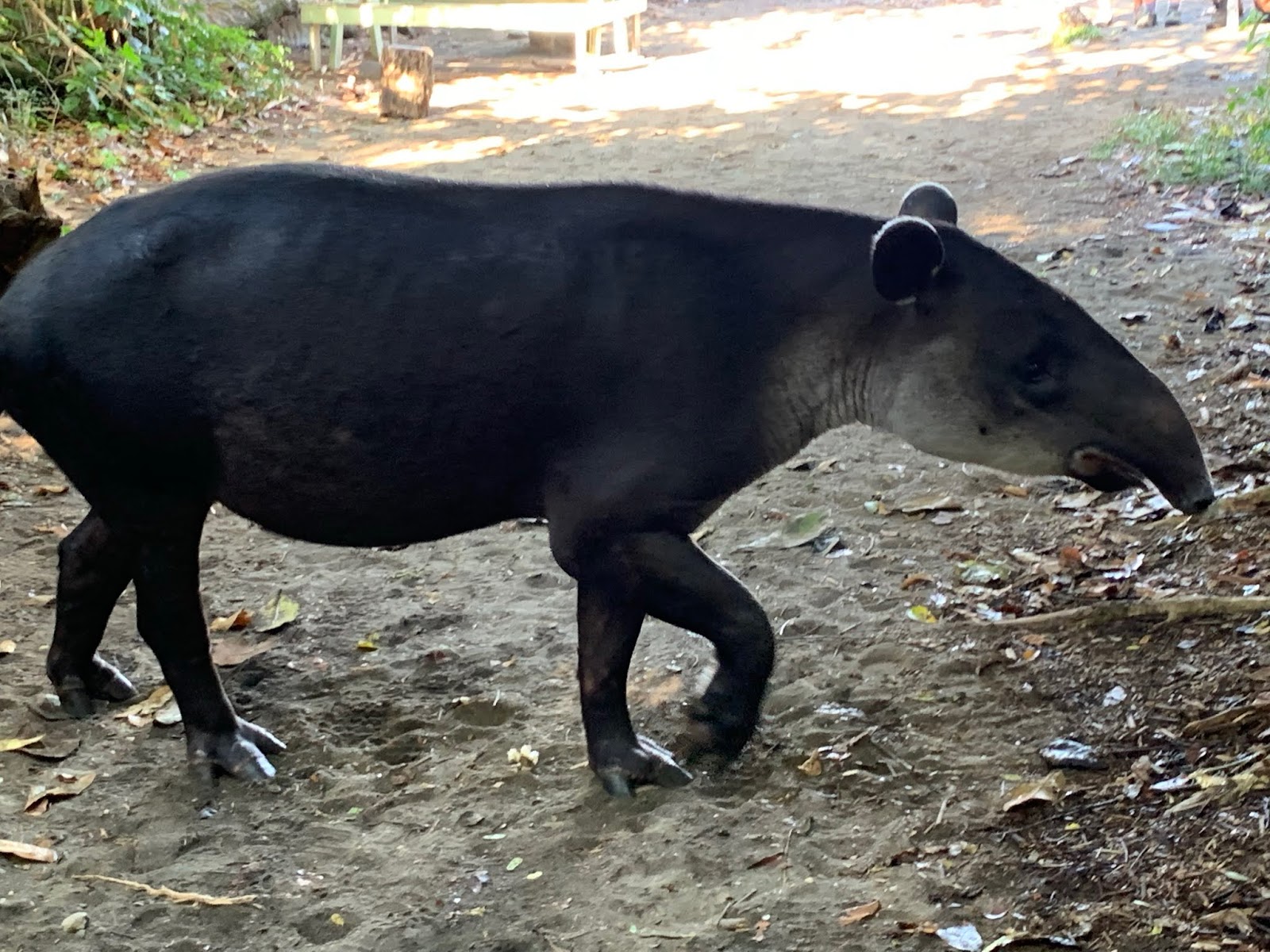
TAPIR, CR
On the Infinity there was free internet and there were Edison electrical outlets. The Panorama only had 220-volt European style plugs and no internet was available. We bought a Foval International Travel adapter with appropriate plugs for our computers and iphones (which I begrudgingly began using recently as a very nice camera).

On board meals on both cruises were excellent. We had a lot of fish in both places. Lunches on the Infinity were sit down affairs, while the Panorama served a buffet lunch.  Janet and I will continually go back and forth about which meals were the best, ALTHOUGH, in Croatia we were offered a beer or wine with our lunch and dinner. That wasn’t the case with the Panorama, but the crew didn’t mind if you made the meal a BYOB. 

COFFEE IN CROATIA

In Croatia we would dock nightly on a new island early enough to explore it, and would often sail the next morning. This way we got to admire the rugged coasts and to take a daily swim off the back of the Infinity in the clearest water I have ever seen. There was a lot of lounging on the Infinity, while the Panorama traveled mostly at night and our shore excursions were all in a group tour, there were no running off to find a coffee or a grappa as was the case in Croatia.

But, the excursions in Costa Rica and Panama were without comparison. One day we had white-faced capuchin monkeys jumping on my shoulder, another we had to make way for a tapir and her offspring and another we tried looking for a 12-foot crocodile named Tito to no avail, but we did get to swim with massive whale sharks. The two destinations were so completely different and yet both equally enjoyable.


THE SCIENCE OF SOAP
Getting back to this Convid19 virus. Let's be clear, don't panic, don't drink bleach. Wash your hands often using soap and water. You'll be fine, but you might ask why is soap so important?

Here is a great article about this very thing and I suggest you read it. It has to do with the fat in soap breaking down the fatty layer that binds the virus together. Without that fatty layer the virus falls apart. Yeah, it sounds boring, but it will save your life and heck you ain't going anywhere right now, so you might as well read it.

THE SCIENCE OF SOAP

juvenile whale shark


© 2020 by Greg Dunaj