Saturday, March 14, 2020

SMALL SHIP SAILING


SELF QUARANTINING  
With Covid19 causing such a panic throughout the world we here at Vacations From Home are happy to be home, safe and symptoms free. We certainly enjoy flitting about the world, but currently we are doing what we all need to be doing, which is keeping your distance from others, drinking lots of fluids, washing your hands frequently and lastly avoid touching your face.

CONVID19

Like modern day Decameron hostages awaiting the Black Plague we have been minimizing our visits to the outside world.

Well, that’s a bit extreme, but we here at VFH central command feel fortunate. Having just returned from a sailing adventure from Costa Rica to Panama, we feel good, not sick. We’re in pretty good shape, and that prognosis is nothing to sneeze at. But, imagine our horror with all the recent news about those massive cruise ships, which are effectively floating petri dishes being quarantined, with some getting sick and some dying. This is serious shit.
 
M/S Panorama
SERENDIPITY AND CHANCE
Considering all the grief going on in the world now, we were quite lucky. We traveled on another small ship along the Pacific coast of Central America and we largely had the ship to ourselves. The M/S Panorama is with Variety Cruises, a Greek company. The Panorama winters here off the coasts of these two beautiful countries before eventually heading home to Greece for the summer sailing season. With a passenger capacity of 49 and a crew of 18 we were able to book our trip when there were only 16 passengers.  Yes, there were more crew than there were passengers! Although the week prior to our trip the Panorama carried 49 passengers and the week afterwards there was evidently a whole mess of birdwatchers coming in from Sweden, our week in paradise was empty. 

We booked passage on the Panorama last minute, i.e. just two months in advance, and we did it through Unforgettable Cruises, whom we sailed with in Croatia last July. And, we got it at half price. Variety Cruises was running out of time and approached Unforgettable to find passengers. Remember, when a ship sails with empty berths it is money lost forever.

M/S Panorama dining room

SIZE MATTERS
Now, the best part of a small ship is the level of attention given to the ship and to her passengers. Obviously, our trip was a unique situation, but a small ship is still safer to maintain with smaller areas on board to apply enhanced sanitation and disinfection procedures. Smaller passenger lists mean a more precautionary measure of hygiene on tour groups. This is on top of the intimate feel of smaller ships getting into ports where those petri dish behemoths can never. It is a more relaxed and intimate journey.

Before we were allowed to board the Panorama, we were given a questionnaire about our travels and if we had been to China, etc. within a certain time frame. I don’t believe we would have been allowed on the ship if we were just flying in from Wuhan, and I understand that on top of that the Variety people are now giving all embarking crew and passengers non-touch temperature screenings before they can board. On a massive cruise ship this is a logistical nightmare, but for the Variety Cruise people it was just another step in their rigorous standards of safety and cleanliness.

COMPARING APPLES TO APPLES
Since we traveled on two different small cruise lines within a year, I want to take this time to show the differences between our experiences, each unique.

We were spoiled by the level of opulence on the M/V Infinity with Unforgettable Cruises. Marbled bathroom floors and a very spacious stateroom though it was on the lower floor. We had the same room on the Panorama, at the bow of the ship, and it was a bit cramped and not marbled, but this is after all a sailing ship not a yacht. The room was still comfortable even if Janet and I had to breathe in unison to fit.
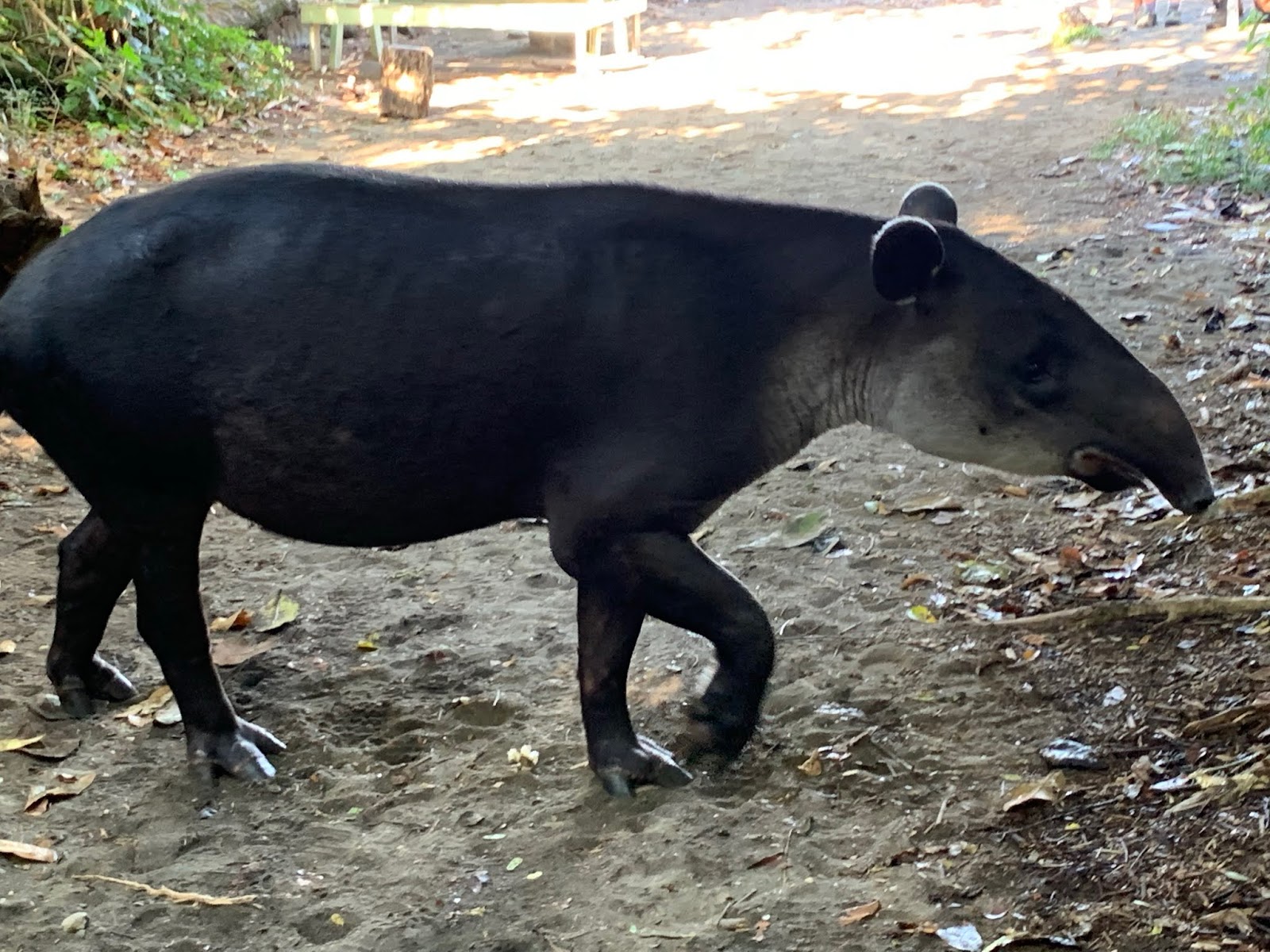
 
TAPIR, CR
On the Infinity there was free internet and there were Edison electrical outlets. The Panorama only had 220-volt European style plugs and no internet was available. We bought a Foval International Travel adapter with appropriate plugs for our computers and iphones (which I begrudgingly began using recently as a very nice camera).

On board meals on both cruises were excellent. We had a lot of fish in both places. Lunches on the Infinity were sit down affairs, while the Panorama served a buffet lunch.  Janet and I will continually go back and forth about which meals were the best, ALTHOUGH, in Croatia we were offered a beer or wine with our lunch and dinner. That wasn’t the case with the Panorama, but the crew didn’t mind if you made the meal a BYOB. 

COFFEE IN CROATIA

In Croatia we would dock nightly on a new island early enough to explore it, and would often sail the next morning. This way we got to admire the rugged coasts and to take a daily swim off the back of the Infinity in the clearest water I have ever seen. There was a lot of lounging on the Infinity, while the Panorama traveled mostly at night and our shore excursions were all in a group tour, there were no running off to find a coffee or a grappa as was the case in Croatia.

But, the excursions in Costa Rica and Panama were without comparison. One day we had white-faced capuchin monkeys jumping on my shoulder, another we had to make way for a tapir and her offspring and another we tried looking for a 12-foot crocodile named Tito to no avail, but we did get to swim with massive whale sharks. The two destinations were so completely different and yet both equally enjoyable.


THE SCIENCE OF SOAP
Getting back to this Convid19 virus. Let's be clear, don't panic, don't drink bleach. Wash your hands often using soap and water. You'll be fine, but you might ask why is soap so important?

Here is a great article about this very thing and I suggest you read it. It has to do with the fat in soap breaking down the fatty layer that binds the virus together. Without that fatty layer the virus falls apart. Yeah, it sounds boring, but it will save your life and heck you ain't going anywhere right now, so you might as well read it.

THE SCIENCE OF SOAP

juvenile whale shark


© 2020 by Greg Dunaj

Wednesday, March 11, 2020

PURA VIDA


TALKING LIKE A TICO
If you want to learn Spanish quickly just remember this phrase, “PURA VIDA”. It will get you far, at least in Costa Rica as ‘Pura Vida” is the acceptable and proper response to practically anything you hear in this beautiful and lush country. From “Como Estas?” (How are you?) to “Disculpe, estoy tarde” (Sorry I’m late), uttering “Pura Vida” along with a smile will have you speaking like a “Tico” (Costa Rican) in no time.
 
MAGNET
“Pura Vida” means literally Pure Life, yet it’s more than a ubiquitous phrase, but a prevailing lifestyle throughout Costa Rica. With an excellent peaceful quality of life and a lovely country it’s easy to see why Ticos have a laid-back and friendly attitude to everything. In Costa Rica it is an easy choice to say, and live, a Pure Life.
KEYCHAIN


And, a lot of people say it.

Our driver from the airport to the resort took back roads to show us some beautiful country and he waved to dozens of people and said “Pura Vida” each time. Our first impressions were that Ticos are friendly people and throughout our stay in Costa Rica, from the tour guides, to the hotel staff, to a saleswoman in a busy touristy Santa Elena shop, we were met with smiles and Pura Vida.. Even the customs officer barely hid a smile as he stamped our passport. 

NO PROBLEM, THAT’S LIFE, JUST BREATHE
“Pura Vida” is heard everywhere, and stamped pretty much on everything souvenir worthy, but this approach to life doesn’t have to end at the border. Yes, living in Costa Rica with an excellent quality of life and beautiful landscapes makes living a laid-back philosophy easy, but here at home we must all remember to slow down, relax, smell the coffee, don’t sweat the small stuff and remember what truly is important in this life. That is Pura Vida.


MAS CERVEZA
Of course, it’s hard to order a beer if you only know how to say “Pura Vida.” The main beer in the Costa Rica is not named Pura Vida, but Imperial. So, learn to say “Mas Cerveza”, or if you’d rather drink the local moonshine order a Cacique Guaro, a distilled hard liquor made from sugar cane juice and very popular in Costa Rica. Effectively it’s a white rum, or a slightly sweet vodka, which works great for mixed drinks….and shots. At the Fiesta Resort, we were drinking Cacique with Fresca, Lime and salt… and shots. People mix Cacique with Pineapple, Coconut or other juices .... or do shots. .

Here's a quick list of Cacique recipes that'll have you drinking like a Tico.  

Now distilled by Fabrica National de Licores for quality control, Cacique is abundant, cheap and strong, Cacique Guaro red is 60 proof and the black-labeled Superior Chief weighs in at 70 proof. Cacique means “Chief” and this distilled liquor is now popular throughout Latin America, but it originated in Costa Rica. Found in every remote corner of the country in every little bar, hotel and restaurant and lining local grocery store shelves, Cacique comes in liter and 750 ml glass bottles and 365 ml pachitas, little plastic bottles for those who require inspiration while traveling.

NO MAS AGUARDIENTE  
INSPIRATION
Hope these Spanish lessons work for you fair reader, but please remember to imbibe wisely. Too much Aguardiente or Burning Water can lead you astray. If you’ve had too much to drink and you say, “Quiero Cacique!” and a half-naked chief wearing an elaborate headdress comes out to greet you, you may have wandered into one of those kinds of bars. Pura Vida, I say. Who am I to judge? Whatever floats your dugout canoe!


PURA VIDA!


We didn't get a chance to drink any craft beer while in Costa Rica, but here is a short list of brewers found there. 
Buy you a drink?
PURA VIDA

Thanks for reading. My pachitas is nearly empty and to buy Cacique I’ll have to return to Costa Rica. So far it has been impossible to find stateside…. So buy something at the store… or my books… or send me a donation.

© 2020 by Greg Dunaj

Sunday, March 8, 2020

MONTEVERDE

I’M WALKING ON SUNSHINE
Before sailing on the M/S Panorama for a week-long excursion along the Pacific coasts of Costa Rica and Panama, we checked into the all-inclusive family style Fiesta resort for a few days. We wanted one day of relaxing at the pool, we had just escaped the wintry climate of Philadelphia after all, and then we planned a day of exploring the natural splendor of Costa Rica.
THE PIER AT FIESTA RESORT, COSTA RICA
One full day at the resort was enough. Schools in Costa Rica had started up, but there were plenty of ninas cavorting in the pool. The adults caroused and sang loudly at the swim up bar. We noticed that there was a fierce competition of gaining the bartenders’ attention right at the opening bell and then later when the liquor kicked in for these thirsty patrons, there was a lull throughout the resort for a well-earned siesta. Later, as the day waned crowds gathered on a pier to revel in the passing of another day. A bar was there, open only for the sunsets and helped to dampen sobriety levels.

SKYWALKER
Janet wanted to go ziplining and I wanted to walk in the clouds. Both activities are popular in Costa Rica where the eco-tourism trade also includes hiking at volcanoes and whitewater rafting and birdwatching as well as two oceans to loll by, the Pacific and the Caribbean.
 
KNUCKLEHEAD
Although I wanted to cater to my maniacal wife’s wish to “zip” between trees, I wanted none of this. Turns out that later in the week one of the tours offered by the Panorama Cruise people was ziplining, so although the Monteverde ziplining course is one of the original courses in Costa Rica, this was not her only opportunity to cheat death. So, we approached the Arenas Travel people located in the hotel lobby and set up a day of rainforests and hills in Costa Rica. First it was a “SKY WALK” along the hanging bridges in Monteverde and then a 3-for-1 four of coffee, cocoa and sugar cane harvesting with the Don Juan plantations. 

LIVING FENCES

LIVING FENCES AND CASHEWS
If you have limited time in Costa Rica, we here at VFH Central strongly suggest going on a tour. They may be expensive, ours cost $320, but you do get your money’s worth. The tour company tailored the day to our interests, replacing the ziplining for the coffee tour.

The trip to Monteverde took 8 hours and included transportation and a guide and lunch in Santa Elena. The guide was knowledgeable and enthusiastic. He stopped often to point out interesting facts about Costa Rica, like to be considered a town four things were necessary, a church, a school, a soccer field and a bar, missing one of these elements it’s just a cluster of buildings. He pointed out the “living fences” where farmers plant branches of the “Naked Indian” or Gumbo-Limbo tree which root quickly and with barbed wire form a fence. He stopped to show us monkeys or fetched a red cashew fruit from a tree and had us eat it.

CASHEW FRUIT

He was also our guide at the Sky Walk which is a combination of trails and suspension bridges that had us at times above many tree tops. At first the wobbly bridges were disconcerting but we were able to see the rainforest from all perspectives from above and below. We looked down on Howler monkeys rustling the trees and colorful humming birds flitting between the trees. He used his tripod and telescope of the monkeys to take a picture for us which turned out to be common practice for all the guides in Costa Rica.


Now it was decidedly cooler at the Sky Walk and when the wind kicked up it was much cooler than oceanside. Because this was a rainforest there is also a chance of getting wet. Many people in other tour groups were dressed for bear, wearing heavy jackets and some were encased in plastic and carrying hiking poles, but it was never that bad. Once on the trail, the winds abated and we were fortunate to not get rained on. Janet and I wore shorts and brought light sweatshirts which was adequate. The trail too was at times somewhat rough, but wearing sneakers was okay. 


MONKEY SEE

You could drive yourself to the Sky Walk park and hire a naturalist guide there if you choose. At Don Juan’s Coffee Plantation our guide handed us off to the staff there while he took another couple to the ziplining. We had to wait for our tour, which gave us enough time savor several cups of free coffee.

MONTEVERDE
The area where the skywalk, ziplining and the Cloud Forest Reserve is called Monteverde, today the main center of eco-tourism in Costa Rica with upwards of 250,000 yearly visitors.

Though the area had been populated throughout history Monteverde was founded and developed by Quakers in 1950. Fleeing the United States and the Korean War they were lured to Costa Rica because that country had abolished its standing army the year before and the President of Costa Rica was inviting foreigners to come in and help develop the country.

The 44 Quakers eventually settled in Monteverde and cleared land and started a dairy and cheese making business, but as time went on realized the importance of preserving the land and forests. They made strident efforts to protect the bio-diversity of Costa Rica through donations and eventually created the Monteverde Reserve. The cheese making facility is still open and some of the original Quakers still live in the area, but our tour was limited in scope and we could not linger. It would have taken days. Janet and I have lamented that we didn’t give enough time to exploring Monteverde.

If you’re interested in reading about the history of the Quakers in Monteverde here is a good website.
  
Thanks for reading.
© 2020 by Greg Dunaj

Tuesday, March 3, 2020

COSTA RICA COFFEE


A BAD CUP OF JOE IS ILLEGAL
Growing coffee in Costa Rica is serious business. According to a law passed there in 1989 only Arabica coffee beans can be grown by Costa Rican coffee farmers. Although Arabica already accounts for 60% of the world’s coffee and is more difficult to grow than hardier stocks of beans, the mature bean is smooth and sweet, and creates a well-balanced cup of coffee when brewed. The other major coffee bean is the Robusta. It may be easier to grow and more resistant to bugs, but it is also higher in caffeine than the Arabica and because of this has a bitter rubbery taste.
 
JANET PICKING COFFEE
Coffee is a relatively new crop for Costa Rica, first introduced in the late 1700’s. Back then anyone who wanted to grow beans was given land by the government to get started. Coffee quickly became an important and lucrative crop for Costa Rica. Today, coffee plantations, mostly found in the Central Valley where rich volcanic soil helps grow a more unique and stronger flavor in the beans, produce roughly 1.4 million bags of 60 kilograms of coffee yearly, the monies generated paying for roads and ports and infrastructure improvements.   

Costa Rica is the perfect place to grow coffee. Arabica thrives in high altitudes with constant warm temperatures and plenty of rain. Temperatures in the higher elevations of Costa Rica vary only ten degrees or so throughout the year, roughly from 63 to 80, and much of the crop is grown on plantations from 2,400 to 3,200 feet in elevation. Average rainfall is anywhere from 78 to 118 inches per year and the soil, enriched by volcanic activity, oxygenates the beans. All of these elements alter the aroma, body, flavor and acidity of the coffee. Similarly, Kona coffee, often considered one of the best in the world is grown in fairly identical conditions with the volcanos, rainfall and elevations of the Big Island.

COFFEE AT DON JUAN CR

CHORREADOR
It is possible to go on a coffee plantation tour to learn the entire procedure, from picking the cherry beans all to way to several methods of brewing coffee. Your favorite highly caffeinated traveling couple went on just such a tour at Don Juan Plantations in Monteverde, not for from the Cloud Forest Reserve, a major eco-tourism destination for Costa Rica.

The informative tour not only showed us the entire procedure of coffee but of cocoa beans and later sugar cane, on a three for one tour. We learned that espresso doesn’t really have a lot of caffeine in it as the water just shoots through the grinds rather than steeping and we learned how to roast green beans in a frying pan and brew a cup of incredibly flavorful coffee in a Costa Rican Chorreador, a wooden-stand drip method of brewing coffee. Of course, Team VFH likes our coffee gadgets and bought a carved and decorated chorreador at the gift shop where we drank so much more free coffee that afterwards we decided to run alongside the Arenas Travel tour van rather than ride inside.


Thanks for reading. There’s so much more, we’re just getting started!

Remember to visit our online store!

Pura Vida!


Saturday, February 22, 2020

COSTA RICA BLACK SAND

BLACK SAND BEACH, COSTA RICA

VOLCANOS
The composition of a beach depends on its location. Most of the beaches throughout the world are ground up brown colored quartz, but the white sands of tropical beaches are actually calcium carbonate which comes from shells and skeletons of marine life and coral reefs. Black sand which is mostly found in Costa Rica’s southern Pacific coast comes from volcanos and is actually volcanic glass that has been ground up by the waves.
 
ARENAL VOLCANO, CR
Costa Rica is part of the Pacific Ring of Fire where much of the active volcanos in the world are located. Currently Costa Rica has five active volcanos and over 100 dormant. They are found in the northern and central highlands of Costa Rica and they are all popular tourist destinations..

Here at the Fiesta Resort in Puntarenas the beach is wide and the sand very fine and its color is black.to gray. It doesn’t have the shiny pure volcanic glass of beaches in say Punalu’u or Kalapana, where recent Kilauea eruptions have added to the girth of the Big Island. Nonetheless it is striking. Across the bay is the rocky horizon of the Nicoya Peninsula where the sand from there is washed ashore in Puntarenas to give it this unique color. In the surf the water looks murky as the fine, soft sand is swirled about,   
BEACH AT FIESTA RESORT, CR

Thursday, February 20, 2020

THE TWO SEASONS OF COSTA RICA


HIGH AND DRY and GREEN ON THE PACIFIC COAST
In the Northeast we have four seasons…winter, spring, summer, fall. Here in Costa Rica there are two, summer and winter. Although Costa Rica is in the Northern Hemisphere, the seasons here in this tropical Central American country are still reversed. We are enjoying the peak summer here on the Pacific coast where nearly all the beach communities are located. Summer lasts roughly from December to April. Winter, which is from May to November is their rainy season here and called the “Green” season. Although the rain during this time can get bad enough to hamper travel especially on the Osa Peninsula, often it will rain a few hours in the afternoon with brilliant sunshine at before and afterwards. 

NOT A SANDALS                                                                 
We are spending three days at the all-inclusive Fiesta Resort in Puntarenas Costa Rica before we set sail on Saturday. The place is brimming with families with many children tossing sugar packets to the floor while at breakfast. Perhaps they are on a summer holiday?  It’s definitely different than our recent stays at a Sandals resort, but the Fiesta resort covers a lot of area and despite the ninos splashing about the pool we are enjoying the black sands and Mai Tai’s nonetheless.

Breakfast at Fiesta Resort

There are two restaurants that require reservations at the Fiesta Resort. One is seafood and the other specializes in latino-flavored cuisine, but as we are only here for three days, we are only eligible for one reservation. Another reminder that we are not at a Sandals. Plus, we are required to wear a plastic wrist-band that denotes our “status”. The room itself is pleasant, although the beds are smaller than we are used to.

THAT’S A LOT OF COLONES
Although Costa Rica can be higher priced than the rest of Latin American countries it is still relatively inexpensive. Costa Rican currency is called the Colon and is currently set at .0018 per USD. So, the price of a keychain at the resort’s gift shop is listed at 4,000 Colones… which is just $7.05… HEY…. We’re not buying everyone trinkets.

Thanks for reading.

Monday, February 17, 2020

LATIN LOVE


ADVENTURERS’ PARADISE of COSTA RICA
Truthfully, central America was never on Team VFH’s radar. Europe, the Caribbean and places in the United States held our interest as travel destinations but, serendipity has altered our travel plans. When we saw a half-priced passage from Costa Rica to Panama available with Unforgettable Cruises, a small luxury ship company, suddenly Latin America was a viable destination.


We have traveled with Unforgettable Cruises before in Croatia and the level of attention and luxury was appealing enough to return to the company. Coupled with the half-price passage and a modest discount they offered us as returning customers made widening our horizons to include this new area of the world an easy choice.
OCELOT

As we gear up and do research for this trip it seems more-and-more we have a great trip ahead of us. Of course, sailing on the M/S Panorama, a three-masted motosailer will be enjoyable enough, but there will be plenty to see and experience on land as well. Right about now Janet and I are wishing we were spending more time before the trip in Costa Rica and afterwards in Panama. There’s so much to do. We have just three days in Costa Rica before we sail.
 
SKY WALK, COSTA RICA
Between canopy or sky walks, literally in the treetops of the rainforest, to zip lining like tethered Tarzans, to white water rafting to visiting coffee plantations to hiking volcanos, to birdwatching to espying the plenty of unusual animals that are only found in Costa Rica, like ocelots, white headed capuchin monkeys and Chestnut-Mandibled Toucans as well as sloths lazing about, we're wishing we had more time to explore. Although we're staying at the all-inclusive Fiesta Resort, we may not simply want to lounge about pool-side. There's so much to see before the cruise ship's people transport us to the Panorama. Although, if we decide to linger at the beaches there's a good chance we'll be able to swim with sea tutrles!

IT’S EASY BEING GREEN
Costa Rica places a huge emphasis on progressive environmental policies and is striving to be as carbon-neutral as possible. Nearly all of the country’s electricity is generated from “green” sources, like hydro, solar, geothermal and biomass and Costa Rica is actively pursuing a reforestation effort to replenish the rain forests within their borders. Big on biodiversity and environmental conservation Costa Rica is a delightful eco-tourist destination. There is so much to do and thankfully the Unforgettable Cruises people have put together a list of land excursions in Costa Rica as well as Panama.
POISON DART FROG

They have a visit planned for the Manuel Antonio National Park, a Titi Forest Canopy tour, a trip to the gardens of Casa Orquideas eco-tourism to learn about all the beautiful vegetation, an Embera Indigenus Community Culture Tour, a tour of Old Panama City and a bus tour of the Panama Canal. Sadly there is a cost for each, but I feel we must take advantage of this new and glorious destination.
 
MANUEL ANTONIO NAT'L PARK
Obviously more will follow… Apart from what we've read from the ship's itinerary, we haven't even starting looking into Panama. Keep coming back as we will post more and more and more.

Also, please remember that you can show your support by not only reading, liking and sharing this blog, but you can also visit the VACATIONS FROM HOME store, for t-shirts and coffee mugs, etc. The link for the store is at the top, and, at the bottom of the blog you will see links to my two novels for sale.